The latest news!

How to choose an ATS in 2026?

Discover our guide dedicated to helping you choose a new recruitment software!

What if your employees became your best allies for the future? 

Your talents of tomorrow are already with you. Discover how internal mobility transforms your talent management, boosts engagement, and secures your future. In a world where there is constant talk of a talent war, the search for meaning at work, and more humane governance, one question deserves to be asked: what if your employees became your best allies in building the future of your company? I explored this topic in an exciting episode of my podcast HR Stay Tuned , alongside Sabine Colson , Investment Manager at Wallonie Entreprendre , an expert in management buyouts and employee share ownership . Together, we discussed strategy, HR, business transfer, emotions... and above all, a different way of doing business. Why talk about management buyout and employee share ownership in 2025? Because the context demands it. The aging of SME leaders makes business succession a critical economic issue. Today's talents (and even more so those of tomorrow) no longer just want to “work”. They want to participate , build , influence . Commitment becomes a strategic factor, not just HR. In this context, the mechanisms of management buyout (MBO) or employee share ownership allow for an internal, gradual, aligned transition. They create continuity , strengthen the local roots and stimulate performance . MBO vs Employee Shareholding: What's the Difference? Two approaches, one same philosophy. ➤ A management buyout is when one or more executives or managers acquire all or part of the company. E.g.: A CEO and their committee take over the company from a founder who is retiring. ➤ Employee share ownership is when the capital is opened up to a broader segment of the workforce. For example: All employees can invest in their company, often through a collective investment vehicle. What these two models have in common: ✅ A desire to sustain the business project. ✅ A strategic involvement of the teams strengthened. ✅ A more shared governance and more humane. When the human becomes strategic What Sabine Colson brilliantly highlights is that these structures are not just economic. They are emotional , human , deeply connected to the corporate culture . “At Technord or I-care, you can see that employees no longer say 'I work for', but 'I am part of'. It changes everything.” – Sabine Colson Employee shareholding creates pride , accountability , but also a new form of shared leadership. Practically speaking, how does one go about it? No need to have an immediate resale project. Here are some concrete ideas to start a strategic reflection: Map your internal talents : who might be ready to take over? to get more involved? Organize open discussion times on the company's long-term vision. Train your teams in governance, finance, risk : commitment comes through understanding. Contact an organization like Wallonie Entreprendre , which can support these transitions, even from the very early stages. And above all: dare to ask the question , even if everything is not ready. My personal feedback When I raised funds for Jobbloom , I also asked myself: what kind of governance do I want? What role for my team in this project? These are topics that deeply challenge our stance as leaders. It's not just about capital or strategy. It's a vision of the company . Of its mission. Of its future. Conclusion: the company as a collective adventure Le management buyout et l’ actionnariat salarié ne sont pas des solutions miracles. Mais ce sont des outils puissants pour réconcilier performance, pérennité et engagement . And what if, instead of looking for an external buyer, we looked around us? What if, instead of looking for solutions to resignations, demotivation, the war for talent... we opened the door to the talents we already have? Thanks to Sabine Colson for her valuable insights.

Corporate Culture: The Secret to an Irresistible Employer Brand

Forget foosball. A strong employer brand isn't what you promise, but what you are. Discover how to make your company culture your greatest asset. In a job market where attracting and retaining talent has become an art, corporate culture is no longer a mere "nice-to-have" option. It's the foundation, the DNA upon which an employer brand that is authentic and, dare we say, irresistible is built. But how do we move from nice words on a poster to a reality that is lived and embodied by every employee? To decipher this fascinating topic, we had the pleasure of discussing with Barbara Vandermaesen, co-founder of the consulting firm Humind, in our latest podcast. With her experience as a consultant and HR director, she provided us with valuable insights on how to build a culture that not only attracts but also makes people want to stay. Let's discover together the secrets to making your culture the most powerful of your assets. What is Corporate Culture, Concretely? Forget the academic definitions. Barbara offers us a much more evocative metaphor: imagine entering a house. Before even seeing the details, you feel an atmosphere. It's the smell, the warmth, the soul of the place. The corporate culture , that's exactly what it is. "It's that soul, that smell, that atmosphere that is created within the organization. [...] It's something that you feel." - Barbara Vandermaesen A strong culture is not one where everyone thinks the same. It's a consistent culture. It's when the experience you have, whether as a candidate, employee, or customer, is the same at every touchpoint. From the wallpaper on Teams to the onboarding , including the way successes are celebrated. The 4 Pillars of a Living and High-Performing Culture So, how do we build this consistency? According to Humind, it all rests on a pragmatic four-dimensional model. To omit any one of them is to risk seeing your beautiful cultural edifice collapse. 1. The Expression: Communicating Your DNA This is the most visible part. It's about defining and clearly communicating who you are. Define your values : What do they actually mean to you? Create a manifesto : Share your story, your "why". Deploy a communication plan : Use all channels (intranet, posters, meetings) to ensure the message is heard. But beware, this is only the beginning. A culture that remains at the stage of expression is an empty shell. 2. Modeling: Embodying Behaviors A value like "innovation" is good. But what does it mean in everyday life? Translate values into observable behaviors : Does "Innovate" mean "having the right to make mistakes"? "Suggesting ideas outside of one's scope"? Leading by example : Managers and executives must be the first to embody these behaviors. If you advocate for collaboration, but the leaders work in silos, the message gets mixed. Train and support : Help your teams understand and adopt these new habits. 3. Anchoring: Aligning Your HR Processes This is where the magic happens (or not!). Your culture should permeate all of your organizational processes, especially your HR levers. Recruitment : Does your hiring process reflect your values ? Are the interview questions aligned? Onboarding : Welcoming new members is a crucial moment to convey the culture. Performance Management : Do you assess and reward the behaviors you want to promote? Internal communication : Your intranet, newsletters, events... everything should reflect your culture. 4. Empathy: Taking the Pulse of Your Organization One can only improve what one measures. To know if your culture truly lives, one must listen. Quantitative surveys : Regular polls to measure adherence to values and the social climate. Qualitative approach : Interviews, focus groups, workshops to understand the nuances. Observation : Pay attention to the weak signals, the informal rituals, and what is said around the coffee machine. By working on these four dimensions in a balanced way, you create a virtuous circle where the culture is continuously strengthened. From Culture to Recruitment: Culture Fit or Culture Add? This is a strategic question that every human resources professional should ask themselves. Should we recruit people who are like us ( Culture Fit ) or people who complement us ( Culture Add )? Culture Fit : It's the path of comfort. We recruit "clones" who integrate easily. The risk? Groupthink, stagnation, and reduced adaptability. The Culture Add : It's the path to evolution. We hire diverse profiles that bring new perspectives and challenge the status quo. It's essential for innovation, but it requires a greater integration effort to ensure the individual doesn't feel like an "alien". The right answer depends on your maturity and your HR strategy . What's important is to consciously make this choice: are we looking to strengthen our current culture or to evolve it? Showcasing Your Culture: Employer Branding in Action Once your culture is defined, embodied, and established, it's time to make it shine to attract the talents that match you. Authenticity above all : Your employer brand should be a true reflection of your internal reality. False promises create disappointments that are costly in terms of turnover and reputation. Internal-External Coherence : The message conveyed on your career site, in your videos, or on Glassdoor must be aligned with the employee experience . Any discrepancy is quickly noticed and harms your credibility. Les Ambassadeurs, vos meilleurs alliés : Le leadership est le premier ambassadeur. Mais ne vous arrêtez pas là ! Identifiez des collaborateurs à tous les niveaux qui incarnent votre culture et donnez-leur les moyens de la partager. Comme le suggère Barbara, pourquoi ne pas les impliquer dans l' onboarding des nouveaux arrivants ? C'est une manière incroyablement puissante de transmettre l'ADN de l'entreprise dès le premier jour. In Conclusion Building a strong corporate culture and an irresistible employer brand is not a sprint, but a marathon. It requires strategy , consistency, listening, and unwavering commitment from leadership . True success is when culture is no longer an "HR project" but everyone's business. It's when every interaction, every process, every communication reinforces who you are. That's how you will not only create a competitive edge to attract the best, but also a work environment where well-being and commitment lead to sustained performance. And you, where are you in building your culture? What are your biggest challenges? Share your experience in the comments!

Why your employer brand is your number one asset for recruiting in 2025

In 2025, a strong employer brand is the number one lever for recruiting the best talent. Discover how to improve your attractiveness, optimize your career site and reduce your recruitment costs thanks to SEO best practices, ambassador testimonies and proven strategies. Practical cases and concrete advice at the end. Introduction: The employer brand, a crucial tool in 2025 In 2025, recruitment is no longer limited to posting a job offer and waiting for applications. The war for talent is intensifying, and businesses need to redouble their efforts to attract and retain the best talent. A strong employer brand has become a decisive factor in distinguishing yourself and convincing the most qualified candidates. According to a study by LinkedIn Talent Solutions , 76% of recruiters consider the employer brand to be a major strategic lever for attracting talent. Another study of Glassdoor reveals that companies with a strong employer image receive 50% more qualified applications and reduce their cost per hire by 43% . In this article, we look at why and how a well-defined employer brand can transform your recruitment strategy. 1. The direct impact of a strong employer brand on recruitment A company with an attractive employer brand attracts talent more easily. But what does that mean in practice? A well-defined employer brand has a direct influence on the perception of candidates , improves talent retention and has a positive impact on employee engagement . A company that takes care of its employer image also sees its job offers perform better on Google for Jobs and LinkedIn . A good employer positioning therefore improves the quality of applications and reduces turnover, a crucial issue for many industries such as hospitality or retail. 📌 Key takeaways: A strong employer brand directly improves the quality of applications and reduces turnover. It shapes talent perception and increases employee engagement. Les entreprises qui investissent dans leur image d'employeur réduisent leurs coûts de recrutement tout en attirant des candidats mieux adaptés. 2. How can you effectively strengthen your employer brand? To build a strong employer brand, several levers must be activated: ✔ An attractive and optimized career site : A well-structured and informative career page is crucial. Include employee testimonials, FAQs about your company culture, and emphasize opportunities for growth. ✔ An active presence on social media : LinkedIn, Instagram, and TikTok have become key platforms for recruitment. One in two candidates checks out a company's social media before applying . ✔ Engaging job descriptions : Write compelling job descriptions that reflect your values and benefits. Use an authentic voice and a clear layout. ✔ Internal ambassadors : Encourage your employees to share their experiences and stories. Genuine content gives confidence to potential candidates. 💡 Example: Google and L’Oréal have boosted their attractiveness by adopting an employer branding strategy focused on transparency and authenticity. Google : a mis en avant sa culture de l'innovation et du bien-être des employés à travers des vidéos immersives sur YouTube et des témoignages partagés sur LinkedIn. Ils ont également lancé un programme d'ambassadeurs internes où les employés partagent leur quotidien professionnel via des blogs et des publications sur les réseaux sociaux. L’Oréal: created engaging HR communication by telling inspiring career stories and offering behind-the-scenes glimpses of the company on Instagram and TikTok. They also encouraged employees to share their experiences on Glassdoor and LinkedIn, strengthening their credibility with potential candidates. 3. SEO and employer brand: Attracting the right talent via your career site Your career site is one of the first showcases of your company for candidates. A poorly referenced or too slow site can negatively impact your ability to attract the right profiles. SEO best practices for a successful career site ✔ Optimization of job listings with relevant keywords. ✔ Using Google for Jobs to maximize visibility and appear at the top of searches. ✔ Quick loading time to prevent drop-offs (53% of visitors leave a page if it takes more than 3 seconds to load). ✔ Mobile-friendly version , because 60% of applicants apply from their phone. 👉 Also to read: SEO Optimization for Job Vacancies: The Complete Guide 4. Case Study: How Leonidas Enhanced Its Recruitment with a Strong Employer Brand Leonidas, an iconic Belgian confectionery brand, needed to attract international talent while strengthening its employer image. By collaborating with Jobloom, they have: ✔ Increased the number of visitors to their career site to 4,500 per month . ✔ Received 500 qualified resumes monthly . ✔ Optimized their employer brand image in Europe, by improving their storytelling and their presence on social networks. 👉 Also to read: Leonidas: Strengthening the Employer Brand and Recruiting Internationally with Jobloom 5. Common mistakes that damage your employer brand Even the most attractive companies can make mistakes that hinder their recruitment. Here are the most common ones: 🚫 A neglected career site → Lack of updates, outdated visuals, candidate journey that is too long or confusing. An outdated site sends the wrong signal to talent. 🚫 Corporate values that are not very credible → A discourse that is too corporate or too far from internal reality creates a dissonance perceived by candidates. 🚫 An absence of HR storytelling → Candidates want concrete and authentic testimonies. Without human content, it's hard to capture their interest. 🚫 A lack of interaction on social networks → No response to comments, lack of commitment from internal teams: this gives a passive image of your business. 🚫 Unattractive job offers → Ads that are too generic, without highlighting the advantages for the candidate. Poor wording can drastically reduce the number of qualified applications. 6. Why will investing in employer branding today have an impact on your recruitment in 2030? Working on your employer brand is a long-term investment. Businesses that start early reap lasting benefits: ✔ Better talent retention → A strong employer brand reduces turnover and improves employee engagement. ✔ Increase in the HR Net Promoter Score → Satisfied employees become your best ambassadors and attract new talent. ✔ Reduced recruitment costs → A better reputation means less dependence on expensive job boards and recruitment agencies. ✔ Adapting to the new expectations of candidates → Flexibility, well-being at work and corporate values have become key criteria in choosing an employer. Conclusion Building a strong employer brand is now a key strategic asset to attract talent and optimize your recruitments. Investing in transparent communication, optimizing your career site, and relying on internal ambassadors can enhance your appeal and reduce recruitment costs. 🚀 Do you need support to strengthen your employer brand and optimize your career site? Contact Jobloom for a free demo! ‍

The KPIs to follow to assess the effectiveness of your recruitment

Discover the 5 essential KPIs to optimize your recruitment in 2025: conversion rate, recruitment time, quality of applications, cost per hire and candidate satisfaction. Improve your HR process and attract top talent with accurate and actionable data. Download our free guide! Introduction: Why measuring the effectiveness of your recruitment is essential in 2025 “If you don't measure, you can't improve.” This saying has never been more pertinent in the field of recruitment. In 2025, confronted with an intensified war for talent and changing expectations from candidates, companies must track key performance indicators (KPIs) to optimize their recruitment process . Far from being mere numbers, these KPIs enable us to answer essential questions: Is my hiring process too long? Am I attracting the right profiles or too many unsuitable candidates? Is my recruitment budget well spent? Is the candidate experience optimized? A study of LinkedIn Talent Solutions shows that 77% of recruiters believe that optimizing HR KPIs has become a strategic priority to enhance their efficiency. In this article, we detail The 5 essential KPIs to be followed in 2025 to improve your performance and guarantee an optimized candidate experience. 1. The candidate to hiring conversion rate One of the first indicators to watch out for is the conversion rate between the various stages of recruitment. It allows you to identify when candidates leave the process and to adjust your strategy. How do you calculate it? Number of candidates hired/Number of applications received x 100 💡 Real-life example: If you receive 500 applications for a position and hire 5 people, your conversion rate is 1% . If this rate is too low, it may indicate a misalignment between your job ad and the profiles it attracts. ‍ According to Glassdoor , companies with an optimized recruitment process see a 30% increase in the conversion rate of qualified applications. 2. Recruiting time (Time to Hire vs Time to Fill) The Time to Hire (time between the first interaction with a candidate and their hiring) and the Time to Fill (total time to fill a position) are crucial for measuring the effectiveness of recruitment. Why is it important? ‍ ✔ Taking too long to hire results in losing top talent to more responsive companies. ✔ It causes an increased workload for teams while waiting for the new hire. ✔ It directly affects productivity and operational costs. 📌 2025 Benchmark: A study by SHRM (Society for Human Resource Management) shows that the average Time to Hire is 24 days , while top-performing companies hire in under 15 days . ‍ 3. The quality of applications Attracting a lot of candidates is good. Attract The good ones , it's better. This KPI makes it possible to know if the candidates who apply really match the needs of the position. How to assess it? ‍ ✔% of candidates who pass the first stage of recruitment. ✔ Matching score (offered by some ATS like Jobloom ). ✔ Retention rate at 6 months: if a new employee leaves their position in less than 6 months, this may reveal a problem of alignment between the mission and the expectations of the candidate. 4. Cost per Hire Effective recruitment should be profitable . The Cost per Hire measures the investment required for each hire. Calculation: ‍ Total cost of recruitment/Number of hires Include in your calculation: ✔ Advertising costs. ✔ Costs of HR tools (ATS, job boards). ✔ Time spent by recruiters. ✔ Training and onboarding costs. 📌 2025 Benchmark: The average cost per hire in Europe is estimated at €4,425 , ranging from €1,500 for SMEs to €8,000 for large enterprises (source: Glassdoor Economic Research ). ‍ 👉 Also to read: How Huggys increased its candidate conversion rate in hospitality by 12 times , a tangible example of recruitment transformation through KPIs, digitalization, and improved application management. 5. Taux de satisfaction des candidats et des employeurs Recruiting does not end with hiring. A good performance indicator is the satisfaction of candidates and managers . How do you measure it? ‍ ✔ Satisfaction questionnaires after recruitment. ✔ Feedback after 3 months regarding the integration of the new employee. ✔ NPS (Net Promoter Score) to measure overall satisfaction. Conclusion Following these 5 strategic KPIs will enable you to enhance your recruitment efficiency, attract the right talent, and optimize your costs. 📘 FREE guide: Optimize your career site and attract top talent ! 🚀 Download our comprehensive guide and discover how to structure your KPIs, improve the candidate experience and boost the efficiency of your recruitments.

Look for candidates where they are

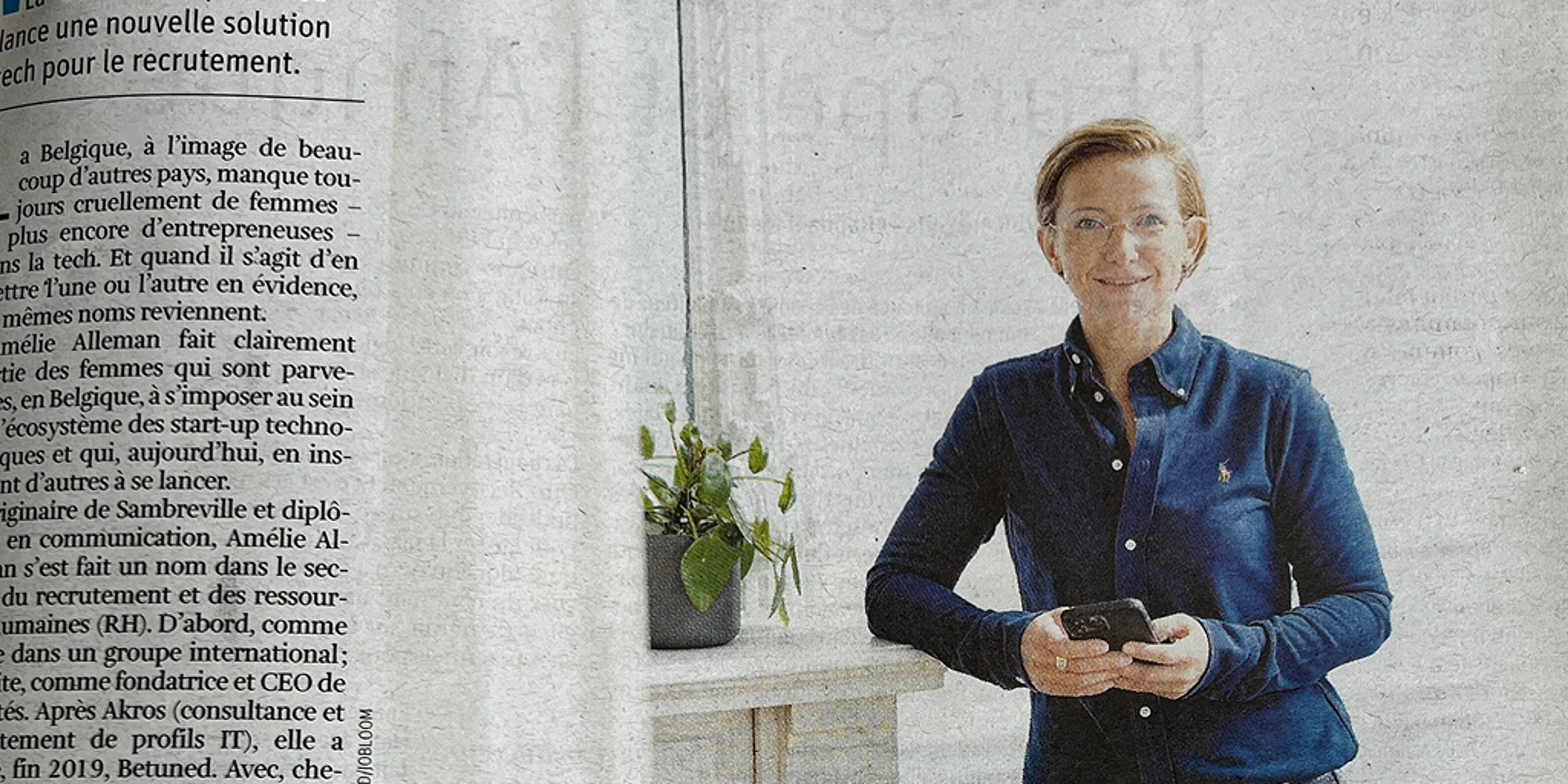
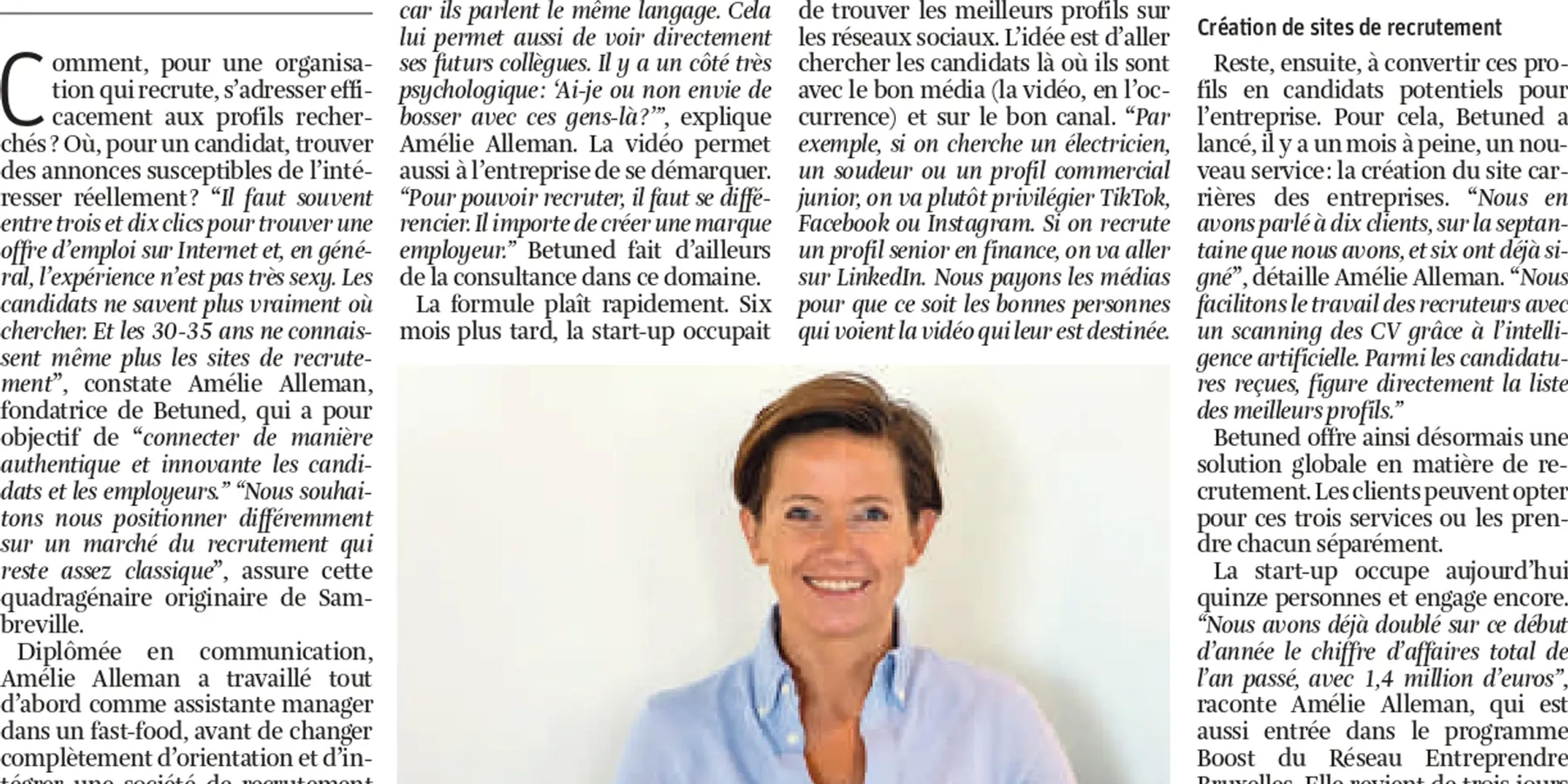
Discover the article by Amélie Alleman, founder of Betuned, in La Libre Belgique. Betuned offers a comprehensive solution to make recruitment more efficient. How can an organization that is hiring effectively address the profiles it is searching for? Where can a candidate find job postings that truly interest them? “It often takes between three and ten clicks to find a job offer on the internet, and generally, the experience is not very appealing. Candidates no longer really know where to look. And those who are 30-35 years old don’t even know the recruitment sites anymore,” observes Amélie Alleman, founder of Betuned, whose goal is to “authentically and innovatively connect candidates and employers.” “We want to position ourselves differently in a recruitment market that remains quite traditional,” assures this entrepreneur from Sambreville. With a degree in communications, Amélie Alleman initially worked as an assistant manager in a fast-food restaurant, before completely changing her career path and joining an IT recruitment company. In 2009, she founded her own consultancy and IT recruitment firm (which has since been sold) and then a second one in the same field. Eager to reinvent the recruitment offering, she launched Betuned at the end of 2019. Behind the scenes Initially, she offers videos of companies that are hiring to show candidates the DNA of the company and what goes on behind the scenes. "We go into the company and we interview the manager and colleagues with whom the future candidate will work. It's interesting for them because they speak the same language. It also allows them to directly see their future colleagues. There's a very psychological aspect: 'Do I want to work with these people or not?'", explains Amélie Alleman. The video also allows the company to stand out. "To be able to recruit, you have to differentiate yourself. It's important to create an employer brand." Betuned also provides consultancy in this area. The formula quickly became popular. Six months later, the startup already employed six people and had about twenty clients. As it expanded, Betuned added a second service to its offering: the creation of digital marketing campaigns to find the best profiles on social networks. The idea is to reach out to candidates where they are with the right media (video, in this case) and on the right channel. “For example, if we're looking for an electrician, a welder, or a junior sales profile, we'll favor TikTok, Facebook, or Instagram. If we're recruiting a senior profile in finance, we'll go on LinkedIn. We pay for the media so that the right people see the video that's intended for them. Digital marketing allows targeting talents,” explains Amélie Alleman, who can search for all types of profiles “because we go to find the candidates where they are.” Recruitment website creation The next step is to convert these profiles into potential candidates for the company. To do this, Betuned launched a new service just a month ago: the creation of career sites for companies. “We discussed it with ten clients, out of the seventy we have, and six have already signed up,” explains Amélie Alleman. “We make the recruiters' job easier by scanning CVs with artificial intelligence. Among the received applications, the list of the best profiles is directly available.” Betuned now offers a comprehensive solution for recruitment. Clients can choose these three services or take each one separately. The startup currently employs fifteen people and is still hiring. “We have already doubled this year's total revenue compared to last year, with 1.4 million euros,” says Amélie Alleman, who has also joined the Boost program of the Réseau Entreprendre Bruxelles. She has just returned from a three-day workshop where she prepared the company's three-year growth plan. In terms of financing, Betuned received a 250,000 euro loan from finance.brussels and at the end of December, received support from two private investors who invested a total of 250,000 euros. “We are considering a larger fundraising round in about a year or a year and a half. To be confirmed.” Would you like to learn more about Betuned or a demo of our services? Do not hesitate to contact us to discuss it! amelie@betuned.be or +32474548989!

Mastering boolean search: your lever to find the best candidates

Switch to proactive sourcing. Our practical guide teaches you how to master Boolean search (AND, OR, "") to uncover hidden talents before your competitors do. Boolean search. This technical term may seem complex or even intimidating at first glance. Many HR professionals hesitate to delve into it. Yet, behind this name lies a candidate sourcing method of formidable efficiency, and much more accessible than it seems. A few minutes of reading will suffice to reveal its fundamental principles and to transform your approach to recruitment. This advanced search technique may seem daunting, but it is an extremely effective solution for identifying qualified profiles on essential platforms like Google or LinkedIn. In a job market where talent is scarce, Boolean search is an often underutilized strategic asset that can give you a head start. Boolean Search: Definition and Fundamental Principle Boolean search is a precise search methodology that relies on logical operators (such as AND, OR, NOT) to refine and target the results of a query. → Its scope is broad: it is just as relevant for finding profiles on Google as it is on professional networks (with LinkedIn being the foremost) or job boards. In summary, whenever there is a search bar, there is a strong likelihood that you can use it to optimize your searches. For instance, to find an experienced front-end developer in Lyon, your Boolean search could be phrased as follows: (front-end developer OR front-end engineer) AND Lyon AND (React OR Angular) AND experience > 5 years Essentially, Boolean search gives you the power to construct a structured query to filter out the noise and only surface profiles that very precisely match your criteria. Why Boolean Search is a Strategic Asset in Recruitment? The main advantage of Boolean search in recruitment lies in its ability to streamline and speed up the sourcing process. By using logical operators, recruiters can refine their searches to target only candidates who perfectly match their requirements. 👍 Considered an insider's sourcing technique, Boolean search allows for a dramatic time-saving. It automatically filters out irrelevant results, enabling you to focus exclusively on the most promising profiles. Moreover, this method provides unmatched agility and adaptability. Recruiters can adjust and modulate their queries in real time to meet the changing needs of the business or market fluctuations. It is an essential tool for identifying top talent quickly and efficiently. 🦾 It is also a skill that few recruiters master perfectly, which gives an undeniable competitive advantage to those who use it. The Essential Boolean Operators to Master Before you start hunting for talent on the web, mastering key operators is essential. Here are the most important ones and their practical application: Operator "AND": This operator is used to narrow down a search by requiring the presence of all the specified terms. It is ideal for combining mandatory criteria. Example: For a Digital Project Manager proficient in English and agile tools in Paris: "Digital Project Manager" AND English AND Agile AND Paris. Operator "OR": The "OR" operator is used to broaden a search by including alternatives. The result will display profiles containing either of the terms. Example: For a Data Analyst or a Data Scientist in Lille: ("Data Analyst" OR "Data Scientist") AND Lille. Operator "NOT" (or the "-") sign: This operator is used to exclude specific terms from your results. Example: To find profiles of experienced salespeople, but without juniors or apprentices: B2B Sales AND experienced NOT junior NOT apprentice. Operator "SITE:": Useful for focusing your search on a single website. It must be in lowercase, followed by a colon and the site's URL, without any spaces. Example: To search for "Marketing Directors" exclusively on LinkedIn: site:linkedin.com/in "Marketing Director". Operator "EXT:": This operator allows you to search for specific file types (PDF, DOCX, etc.), very useful for finding resumes online. Example: To find resumes for "Management Controller" in PDF format: CV "Management Controller" ext:pdf. Refine your searches using punctuation Beyond operators, punctuation is your ally for even more surgical queries. Guillemets (" ") : Utilisez-les pour rechercher une expression exacte. La recherche ne remontera que les résultats où les mots apparaissent dans cet ordre précis. Example: "Human Resources Manager" will target this exact position, and not profiles containing "manager" and "human" separately. Parentheses ( ) : They are crucial for grouping terms and controlling the order in which operators are applied, especially when combining AND and OR. Example: For an experienced salesperson in Bordeaux or Toulouse: Sales AND (Bordeaux OR Toulouse) AND experience > 3 years. Asterisk (*) : The asterisk acts as a wildcard that replaces the end of a word. It allows finding all variations from the same root. Example: searching for recrut* may yield results for "recruiter", "recruitment", "recruiter", etc. Putting into Practice: Concrete Example of a Boolean Search Let's imagine we are looking for a Customer Service Manager for the e-commerce sector in Brussels, who is bilingual. An initial search on Google could be: site:linkedin.com/in ("Customer Service Manager" OR "Head of Customer Service") AND Brussels AND "e-commerce" To further refine and exclude profiles that are too junior or internships, while including Dutch as an alternative to bilingualism, the query becomes: site:linkedin.com/in ("Customer Service Manager" OR "Head of Customer Service") AND Brussels AND ("e-commerce" OR retail) AND (bilingual OR Dutch) -junior -intern Do you see the power of the tool? It's the same principle that applies to your personal searches. Next time you're looking for a smartphone, try: smartphone AND "OLED screen" AND (battery life > 24h) -refurbished. 5 Practical Tips to Optimize Your Boolean Searches Eliminate broadly: Use the NOT operator (-) from the start to exclude irrelevant profiles (experience levels, sectors, statuses...). Target with precision: Combine AND and OR to identify talents with niche skills or specific combinations of expertise. Combine smartly: Do not hesitate to create complex queries to discover unique profiles that simple searches never reveal. Iterate and refine: Your first query is never the last. Analyze the initial results and adjust your operators to improve relevance. Capitalize on your work: Save your most effective queries in a shared document (such as Excel or Notion). You will save precious time for your future recruitments. Conclusion Mastering Boolean search is a fundamental first step in turning your sourcing into a true strategic advantage. It's the art of asking the right questions to search engines to get answers of unmatched relevance. However, finding the best talent does not stop there. To go further and optimize your entire process, from attracting candidates to their integration, it is essential to rely on expertise and appropriate tools. At Jobloom , we help businesses structure and professionalize their hiring processes to attract and retain the best candidates in the market. Ready to make every recruitment a success? Discover how Jobloom can enhance your recruitment strategy. ‍

Presenting your company in an interview: 7 steps to convince a candidate

In a competitive market, the candidate is also evaluating you. Turn your company presentation into a compelling pitch. Discover 7 steps to convince the best talents. The job interview represents a pivotal moment, a dual-stakes meeting where the candidate and the company mutually assess each other. Historically, the pressure was predominantly on the candidate, who was required to prove their worth and stand out. But the landscape of work has changed. In a market where talent is scarce, the power dynamics have rebalanced. In high-pressure sectors like tech or digital marketing, recruiters are well aware: it is now up to them to seduce, persuade, and present their organization in its most attractive light to attract the best profiles. Today, it is acknowledged that businesses must master the art of "selling" themselves. Your employer brand, your value proposition (EVP), and corporate videos on your career site lay a solid foundation. However, the interview remains the moment of truth. Once you are face to face with a promising candidate whom you wish to see continue the process, it becomes crucial to know how to articulate a presentation that truly makes them want to join you. 1. Before speaking, listen: understand the candidate's motivations The secret to a powerful speech? It starts with active listening. Before you unfold your pitch, take a moment to probe the candidate's true aspirations. Ask them about their ambitions, what motivates them daily, their non-negotiable values, and their long-term career goals. This listening phase will provide you with valuable insights to tailor your presentation and highlight aspects of your business that will resonate with its specific expectations. 2. Go beyond the job description: clarity above all It is certain that your candidate has studied the job offer before coming. However, a job description, no matter how detailed, often leaves room for questions and areas of uncertainty. Your role is to anticipate these questions. Take the initiative to spend a few minutes on a clear and concrete presentation of the role to be filled. Articulate the responsibilities and expected tasks clearly. Use tangible examples so that the candidate can concretely envision their daily routine. Make sure to address the following points: The daily tasks and key responsibilities of the position. The structure of compensation (fixed salary, variable portion, bonus calculation methods). The entire range of social benefits and "perks" (health insurance, meal vouchers, remote work, etc.). The work environment: schedules, organization, position in the organizational chart, introduction to the future team. 💡 Keep in mind that a candidate who leaves with doubts is one who will look for certainty elsewhere. A successful presentation involves putting yourself in their shoes and answering their questions before they even ask them. 💡 Long perceived as a risk, transparency has become a cardinal quality. However, I prefer the term clarity . The challenge is not to say everything, but to say things simply, without jargon, and with sincerity. This approach demonstrates a culture of openness and trust that will reassure the candidate and strengthen their desire to join your team. 3. Give meaning: share the company's vision and mission There's no need to be a charismatic visionary to inspire a candidate. It's an essential step to add depth to your presentation. Prepare some impactful sentences that encapsulate the purpose of your company: what is its mission, what values motivate your employees every morning, and what are the major goals it strives for? Here again, brevity is key! 🦜 🎯 Avoid generic speeches and be direct. Your values embody the ethical and cultural foundations of the company. By making them explicit, you give candidates a glimpse of what drives you and allow them to see if they identify with them. 🎯 Continue by outlining the medium and long-term vision. Demonstrate that your company is ambitious and has a clear roadmap. The candidate will then feel like an integral part of a meaningful and forward-looking project. 4. Embody your values through storytelling Storytelling is an extremely effective communication tool. Its power lies in a simple principle: the human brain remembers information much more easily when it is integrated into a narrative. 👍 For instance, instead of just stating that "internal evolution is a priority", tell the specific story of Marc, "who joined the company three years ago as a technical support apprentice and who, thanks to his proactivity and internal training, is now leading a major strategic project." 🎯 By incorporating real-life stories into your speech, you bring your company culture to life. You make it tangible, authentic, and memorable. 📣 By sharing selected anecdotes and concrete examples, you vividly illustrate your values, successes, and work environment. ❤️‍🔥 Storytelling creates a strong emotional connection with the candidate, a factor that can weigh heavily in their final decision. By projecting themselves more easily, they intuitively understand how your company works and already feel more committed. 5. Project the candidate into the future: the prospects for evolution To convince today's talents, it is essential to talk to them about tomorrow. 👍 Highlight the professional development opportunities within your organization. What will your company look like in 3 or 5 years? What kinds of skills will you need? What concrete measures are you implementing to help your employees grow? -> Detail the possible career paths, illustrating with actual trajectories within the company. -> Mention the training programs (internal or external) that allow for skill development and staying at the forefront of one's expertise. 💡 If you offer mentoring programs or individual coaching, it's a major asset to highlight. It demonstrates a strong commitment to the professional and personal development of your employees. 6. Proof by example: illustrate your concrete successes 🏆 A company is also defined by its achievements. To persuade a candidate to join your ranks, it is essential to provide them with tangible evidence of your successes. → Highlight flagship projects that you have successfully completed, explaining their impact and the quantified results achieved. → Share testimonials or case studies that illustrate the quality of your services or the innovative nature of your solutions. → Provide some easy-to-remember figures or performance indicators (KPIs): your market position, number of clients, growth rate, etc. 💼 These factual elements establish your credibility and prove your ability to achieve your goals. It's a strong rational argument that can tip a candidate's decision. 7 BONUS: The transparency of the recruitment process, a sign of trust "The way you recruit reveals who you are." Your recruitment process is much more than a series of administrative steps. It's the very first showcase of your organization and the consideration you have for your future employees. Clearly explain the process of operations: the different stages, the points of contact, the evaluation criteria, and the estimated response times between each phase. 👍 Highlight what makes your process unique: do you conduct case studies? Informal meetings with the team? Do you offer constructive feedback to all candidates? → By being transparent and detailed about your process, you send a strong signal of professionalism and respect. You show the candidate that you value the time and energy they dedicate to you. Conclusion Mastering your company's presentation during an interview is an essential first step. But to attract and sustainably convert the best profiles, it is necessary to optimize your entire candidate experience, well before the interview. This is precisely where Jobloom assists you in getting ahead. We help you build an efficient recruitment ecosystem with: 👍 A tailor-made career site : We create a personalized career site for you, with content specifically designed to attract the profiles you are looking for. 👍 A smart ATS : Simplify and manage all your recruitment processes from an intuitive and powerful platform. 👍 Video job offers : Transform your listings into engaging video snippets, broadcast through highly targeted digital campaigns to reach talent where they are. 👍 Employer Branding Consulting : Our experts assist you in defining and implementing your employer DNA to stand out as a top choice company in the long term. 🚀 🌟 ‍