This summer, I had the pleasure of being invited to participate in Geoffroy Josquin's podcast "Les Entrepreneurs Inspirants". It was a really nice moment of sharing with Geoffroy.
We talked about:
• The importance of innovation in recruitment
• The origin of Betuned and what motivated me to get started
• The team, having the right people in the right place
• The human challenges that can be encountered
• How to juggle being a mom and a business owner
A big thank you to Geoffroy Josquin for this enriching conversation. I hope it will inspire others to embark on entrepreneurship!
Discover the video podcast on YouTube: https://www.youtube.com/watch?v=jTtcBGChFJA
The podcast is also available on all traditional podcast platforms: Spotify, Deezer, Apple Podcasts, Google, Amazon
Happy listening!

The latest

We thought we needed a powerful ATS. In reality, we needed an efficient ATS.
That’s what one of our clients realized when they decided to switch from Workday to Jobloom. This SME was already using our career site and our multi-posting solution. For its ATS, it had chosen one of the global market leaders. Yet in day-to-day use, it wasn’t power that made the difference. It was simplicity, speed, and efficiency. 🚀 Then came a simple question: 👉 Why are our recruiters spending so much time in their tool? Digging deeper, several frustrations emerged: ❌ Complicated collaboration with several hiring managers ❌ Impossible to easily find a candidate already met a few months ago in the database ❌ Tedious multilingual posting ❌ Reporting poorly aligned with the KPIs actually tracked by the company ❌ Few tools to showcase job ads on social media The result? They decided to replace their ATS with that of Jobloom Not to get more features. But to get the right features. ✅ Smart search in the candidate database thanks to AI ✅ Smooth collaboration between recruiters and managers ✅ Simplified multilingual posting ✅ Reporting tailored to their indicators ✅ Automatic creation of carousels to promote jobs Sometimes, the best solution isn’t the biggest one. It’s the one that truly meets your teams’ needs. And you, how many features of your ATS do you actually use on a daily basis? 🤔

Recrutement_Final_V7_Definitif_Bis_V2.xlsx
If this filename looks normal to you... it might be time to get yourself an ATS. 😅 At first, Excel gets the job done. Then come: ➡️ 150 applications ➡️ 4 recruitments in parallel ➡️ CVs in Outlook or in Dropbox folders ➡️ Comments in his notebook ➡️ Managers who keep asking: "Where do we stand?" And suddenly, you’re spending more time managing your file than recruiting. The problem isn’t Excel. The problem is that Excel works with rows. No candidates. No processes. No recruitment. In 2026, with AI, job boards, and hundreds of applications sometimes arriving within just a few days, continuing to recruit using Excel is a bit like trying to steer your company’s growth with a spreadsheet. It works. Until the day it stops working. I explored this topic in my latest article. And let’s be honest… who’s already worked on a version even longer than the one in the title? 😂

What if AI made recruitment more human?
Yesterday, a prospect told me something that every ATS vendor should hear. "I'm looking for a solution that will free up my time thanks to AI so I can put humans back at the heart of recruitment." Not to recruit without recruiters. Not to replace HR. Not to automate human relationships. But to win back time. We sell AI as a machine capable of replacing humans. In the field, I see exactly the opposite. Recruiters are drowning in administrative tasks. What they want is less data entry. Fewer clicks. Less admin. And more conversations. More listening. More closeness. Technology should never be the hero of recruitment. The hero is the recruiter. Technology should simply allow them to do what they do best: create human connections.

I’ve analyzed hundreds of SME job postings.
Most of them still look like this: “We’re looking for a dynamic, autonomous, versatile candidate… to join a great team.” What that means for the candidate: Nothing. Absolutely nothing. Today, the best job ads answer 3 questions: • Why you? • Why this job? • Why now? And I’d add a bonus: What’s our company vision? Recruitment has become marketing. Yet very few companies have understood this.
You might also like
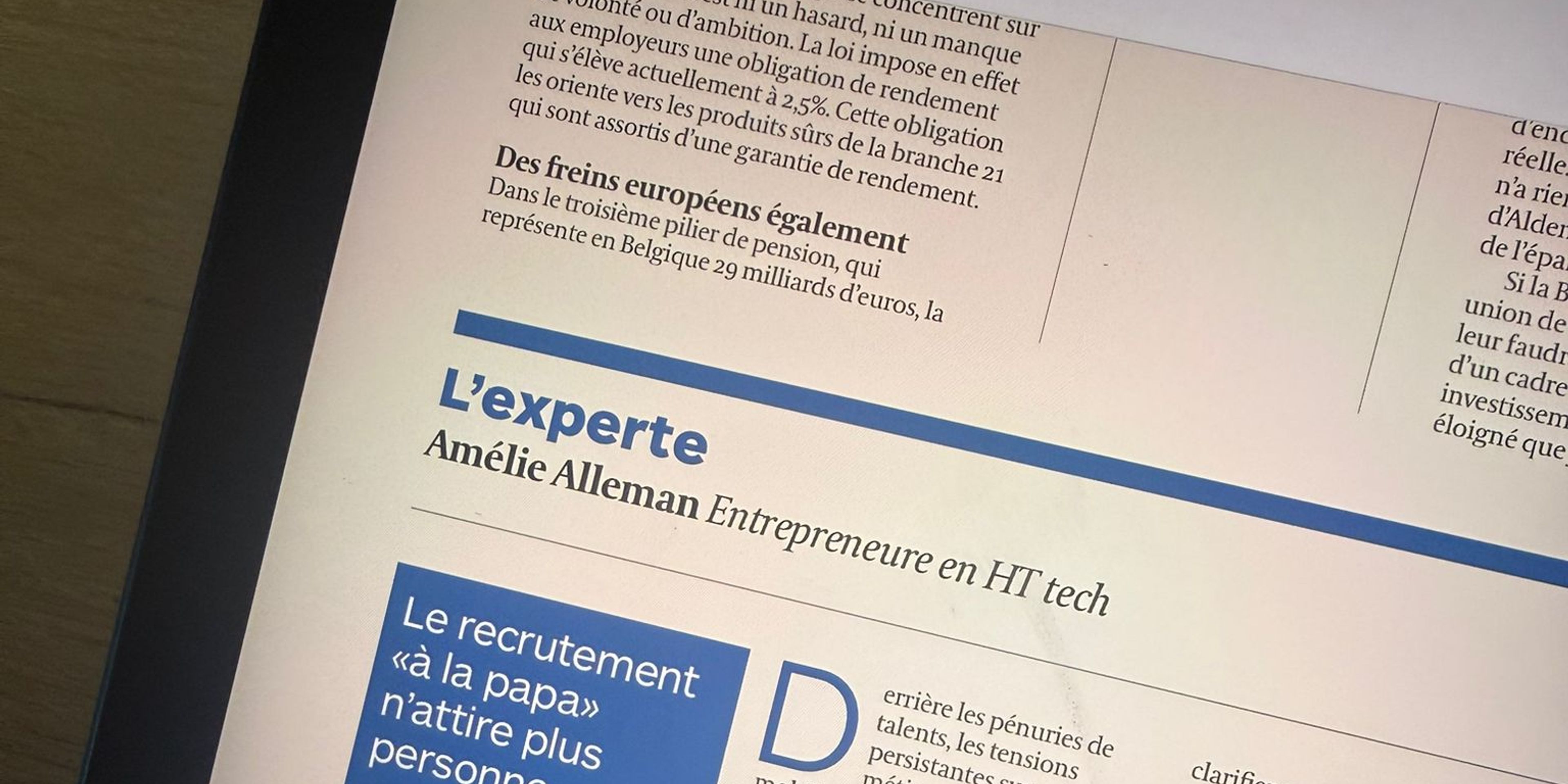
Old-school hiring doesn’t hire anyone anymore, carte blanche in L’Echo
Recruitment is a showcase. Companies that struggle to hire are often those whose practices don’t match their rhetoric. Behind talent shortages, ongoing tensions in certain professions, and the low mobility observed in the job market lies an issue far broader than a simple human resources problem. Recruitment has become one of the most reliable indicators of how companies are actually governed—and of their ability to make decisions, stand by their choices, and plan for the long term. When recruitment stalls, it’s not just positions that remain unfilled. Career paths become frozen, decisions fail to materialize, and value is no longer created. This dysfunction is rarely due to an absolute shortage of skills. Much more often, it is a symptom of organizations that struggle to clarify who they are, what they expect, and what they are prepared to offer. Very observant talents In many companies, recruitment is still treated as an operational, reactive function, sometimes purely administrative. A job ad is posted, a few channels are activated, and then people are surprised that applications don’t come in as expected or don’t match what they’re looking for. That way of thinking belongs to another era. Today, the recruitment funnel no longer starts with the job offer, but with perception. Before applying, talented people observe. They read, compare, and assess the credibility of a project and the consistency of its message. They try to understand how decisions are made, what the relationship is to power, autonomy, and responsibility. In other words, they evaluate governance long before they consider a position. This reality becomes particularly clear in the candidate experience. Response times, clarity of the process, quality of interactions, ability to make decisions: every touchpoint says something very concrete about the company. Far more than institutional speeches or the promises displayed on a careers site. The lived experience never lies. SMEs are more exposed In SMEs in particular, where responsibilities are concentrated and communication channels are short, recruitment acts like a magnifying glass. It is often at this very moment that candidates understand what it really means to work in this organization: where the grey areas lie, how trade-offs are made, and how much room is given to trust and initiative. Recruitment is therefore not just an entry gate. It is a stage where everything is on display. And like any stage, it forgives neither improvisation nor inconsistency. Companies that struggle to recruit are often those that struggle to make decisions, to set priorities, and to align their practices with their rhetoric. Every interaction with talent says something very concrete about the company. The experience people have never lies. Conversely, those who are getting ahead have understood that recruiting is neither a collection of tools nor a series of best practices. It is a coherent system, aligned with a particular way of leading. They are not trying to attract everyone. They fully own what they are, what they are not, and what they no longer want to be. Because recruiting is never a neutral act. It means accepting certain skills, rejecting others, opening up or closing off career paths. With constant hesitation and half-measures, old-school “dad-style” recruiting ends up not hiring anyone at all. Conversely, clear, demanding, and fully owned recruitment says something essential: the company knows how to make decisions—and it knows where it’s going. Amélie Alleman - Opinion piece published in L'Echo - 27 February 2026

Amélie Alleman invited on LN24: Jobloom at the heart of HR news
Amélie Alleman, founder of Jobloom and Betuned , was recently a guest on the news channel LN24 to discuss the challenges of recruiting in SMEs and how technology can transform the candidate and recruiter experience. During this interview, she reflects on her entrepreneurial journey, the origins of Jobloom, and the challenges that small and medium-sized enterprises face in attracting the right talent in a competitive market. She explains how Jobloom enables SMEs to create a dynamic career page, distribute their job offers with a single click, and manage applications easily thanks to artificial intelligence. A clear, concrete, and inspiring exchange on the future of digitalized recruitment.
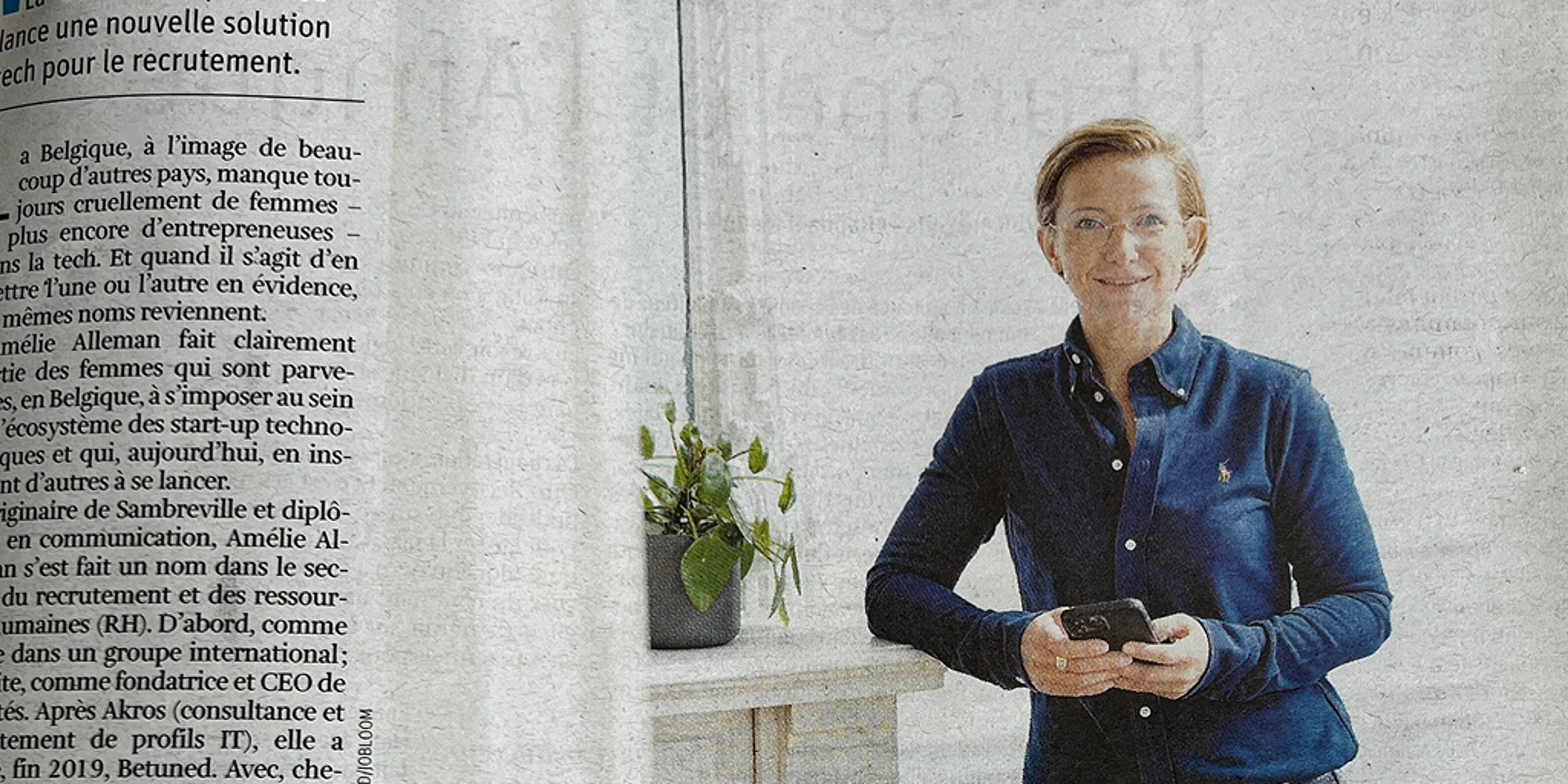
Discover Jobloom in La Libre Echo.
La Libre Echo features Amélie Alleman, founder of Jobloom, in an inspiring portrait of her entrepreneurial journey and the creation of a recruitment solution designed for SMEs. An article that looks back at the birth of Jobloom, its innovative positioning, and its mission: to simplify recruitment through technology. Amélie Alleman honored in La Libre Echo : a look back at the genesis of Jobloom We are pleased to share a great article published in the weekend edition of La Libre Echo (April 26-27, 2025), which devotes an entire page to Amélie Alleman, founder of Jobloom and Betuned . In this portrait, journalist Pierre-François Lovens reflects on Amélie's entrepreneurial journey and how her two projects – complementary and decidedly focused on innovation – are reinventing recruitment in SMEs. The article highlights the origin of Betuned , a specialized agency in employer branding through video, and then the natural evolution towards Jobloom , an all-in-one SaaS platform designed to digitize, automate, and simplify the entire recruitment process. Amélie shares transparently her transition from the service sector to tech, her pragmatic approach to AI applied to HR, as well as the vision behind Jobloom: to make recruitment simpler, more human, and more efficient for companies that don't have the time or resources of a large group.

Betuned is being talked about in Trends-Tendances!
Re-Connect, the podcast inspired by the eponymous book by Georges-Alexandre Hanin, features entrepreneurs and their stories. This week, Amélie Alleman was on the microphone! Amélie Alleman has already founded two companies. The first with a partner whose skills complemented hers, the second, she wanted to launch on her own. Her overflowing creativity provided her with countless resources that she tapped into in unexpected ways to equip herself in areas that were less familiar to her. Listen to the episode on Spotify or on Apple Music . 📢 Discover all the Betuned services: make an appointment You can also contact us: amelie@betuned.be or 0474548989
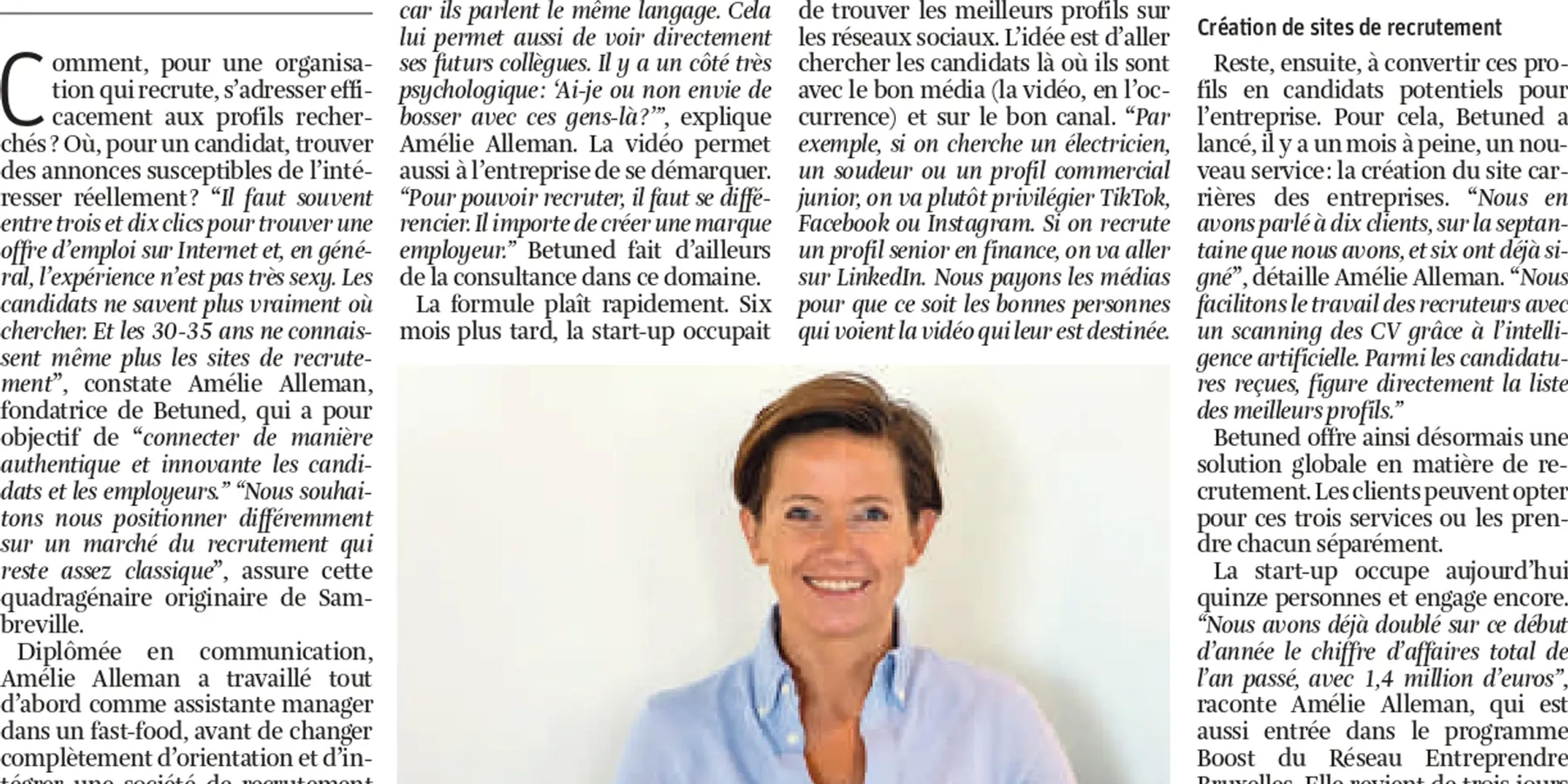
Look for candidates where they are
Discover the article by Amélie Alleman, founder of Betuned, in La Libre Belgique. Betuned offers a comprehensive solution to make recruitment more efficient. How can an organization that is hiring effectively address the profiles it is searching for? Where can a candidate find job postings that truly interest them? “It often takes between three and ten clicks to find a job offer on the internet, and generally, the experience is not very appealing. Candidates no longer really know where to look. And those who are 30-35 years old don’t even know the recruitment sites anymore,” observes Amélie Alleman, founder of Betuned, whose goal is to “authentically and innovatively connect candidates and employers.” “We want to position ourselves differently in a recruitment market that remains quite traditional,” assures this entrepreneur from Sambreville. With a degree in communications, Amélie Alleman initially worked as an assistant manager in a fast-food restaurant, before completely changing her career path and joining an IT recruitment company. In 2009, she founded her own consultancy and IT recruitment firm (which has since been sold) and then a second one in the same field. Eager to reinvent the recruitment offering, she launched Betuned at the end of 2019. Behind the scenes Initially, she offers videos of companies that are hiring to show candidates the DNA of the company and what goes on behind the scenes. "We go into the company and we interview the manager and colleagues with whom the future candidate will work. It's interesting for them because they speak the same language. It also allows them to directly see their future colleagues. There's a very psychological aspect: 'Do I want to work with these people or not?'", explains Amélie Alleman. The video also allows the company to stand out. "To be able to recruit, you have to differentiate yourself. It's important to create an employer brand." Betuned also provides consultancy in this area. The formula quickly became popular. Six months later, the startup already employed six people and had about twenty clients. As it expanded, Betuned added a second service to its offering: the creation of digital marketing campaigns to find the best profiles on social networks. The idea is to reach out to candidates where they are with the right media (video, in this case) and on the right channel. “For example, if we're looking for an electrician, a welder, or a junior sales profile, we'll favor TikTok, Facebook, or Instagram. If we're recruiting a senior profile in finance, we'll go on LinkedIn. We pay for the media so that the right people see the video that's intended for them. Digital marketing allows targeting talents,” explains Amélie Alleman, who can search for all types of profiles “because we go to find the candidates where they are.” Recruitment website creation The next step is to convert these profiles into potential candidates for the company. To do this, Betuned launched a new service just a month ago: the creation of career sites for companies. “We discussed it with ten clients, out of the seventy we have, and six have already signed up,” explains Amélie Alleman. “We make the recruiters' job easier by scanning CVs with artificial intelligence. Among the received applications, the list of the best profiles is directly available.” Betuned now offers a comprehensive solution for recruitment. Clients can choose these three services or take each one separately. The startup currently employs fifteen people and is still hiring. “We have already doubled this year's total revenue compared to last year, with 1.4 million euros,” says Amélie Alleman, who has also joined the Boost program of the Réseau Entreprendre Bruxelles. She has just returned from a three-day workshop where she prepared the company's three-year growth plan. In terms of financing, Betuned received a 250,000 euro loan from finance.brussels and at the end of December, received support from two private investors who invested a total of 250,000 euros. “We are considering a larger fundraising round in about a year or a year and a half. To be confirmed.” Would you like to learn more about Betuned or a demo of our services? Do not hesitate to contact us to discuss it! amelie@betuned.be or +32474548989!