The HR Director interrupted me halfway through the demo. “Could you go back to the previous screen?”

I had just shown her how a job posting, written once, could be published in a single click across more than 100 platforms and partner sites.

But she wanted another look at everything Jobloom could do.

She looked at the screen for a moment, then said:

“I'm tired of HR being the department that has innovation imposed on it. Never the one that drives it.”

She had supported plenty of transformation projects. Every time, her team was there to explain decisions, train managers, and reassure employees.

HR was essential to making change succeed.

But rarely the driving force behind it.

Meanwhile, their own needs were put on hold. Under the same pressure as everyone else: do better, move faster, with the same resources.

Now she was seeing something she could put forward herself. A project rooted in her team's needs that could genuinely change how they recruit. And show her colleagues that HR, too, could teach them a thing or two about innovation.

We talk a lot about the time our clients save with Jobloom.

It's tangible, measurable, and valuable.

But I hadn't realized we could also help change how they're seen within their companies.

What about you? What's the latest innovation your HR department has brought to your company?

The latest

I invested my savings in a SaaS business. The revenue is recurring. So are the 3 a.m. wake-ups. 

Jobloom, our recruitment tool for small and medium-sized businesses, runs on a SaaS model: online software sold by subscription. On paper, it’s a great model: every new client adds their subscription to the rest. But only on paper. Because before you collect those first subscription payments, you have to fund the development of the tool. Then keep improving it, fixing bugs, and covering security and hosting. And find clients, of course. Then support them. You start spending long before you know how quickly sales will follow. I knew all that when I started. But between understanding a business model and living with it, there are a few 3 a.m. wake-ups. There’s the cash flow forecast you redo for the umpteenth time on a Sunday evening. The demo that goes brilliantly, followed by the prospect who vanishes into thin air. And the responsibility that doesn’t end when you close your laptop. It’s hard. Much harder than I imagined. This summer, after 18 months, we finally came close to breaking even! But handling sales on my own wasn’t going to get us to our growth goals. So we decided to invest in a sales and marketing team. And here we go again: new expenses, new risks, and that same pressure on cash flow. Growing also means accepting that you have to put the stability you worked so long to build back on the line. What keeps me going is this belief: WE’RE GOING TO MAKE IT! 😊 Today, we can see our hard work paying off. Above all, I see the difference our tool makes for the small and medium-sized businesses that use it. They save time and make better hires. That’s why we created Jobloom. And it works. Are you hiring? Message me! I can’t wait to show you what we can help you gain. Are you a founder who can relate? Let me know in the comments. We’ll feel less alone. 😊

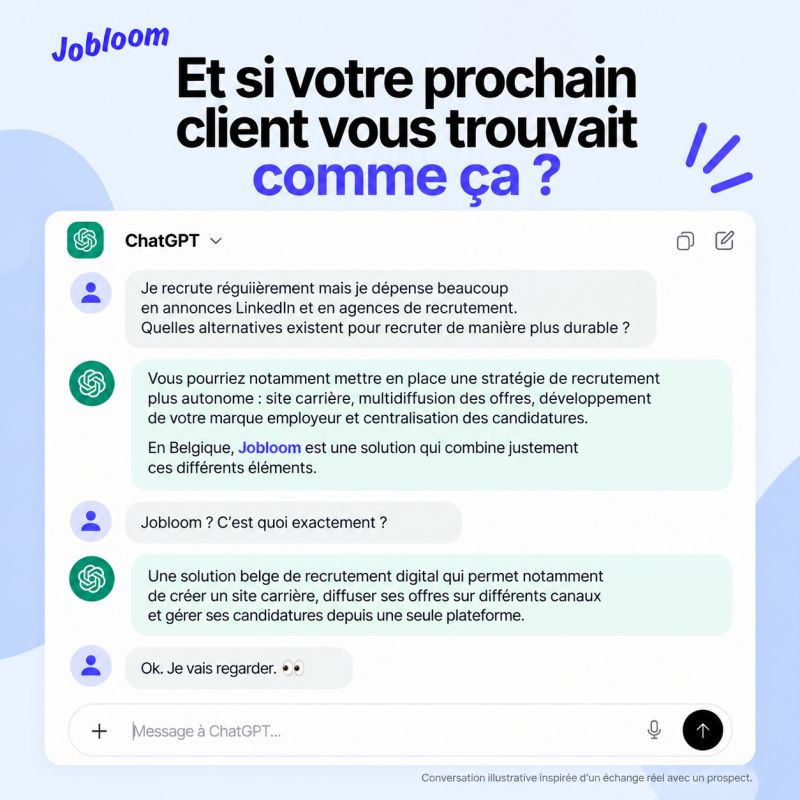
“ChatGPT told me about you.” 

Last week, I heard those words during a demo of Jobloom . And not just once. Two prospects had found us through ChatGPT. 🤯 One of them had asked this question: I spend a lot on job ads and recruitment agencies. What could I do differently to build something more sustainable? Among the solutions ChatGPT suggested: Jobloom. For years, when starting a business, we would ask ourselves: “How do I rank first on Google?” Today, a new question is becoming impossible to ignore: “What does ChatGPT say when someone looks for a solution like mine?” And above all, does it mention me? Because our future customers no longer all search the same way. Some Google it. Others ask an AI directly: “Here’s my problem. What solutions are out there?” And last week, for two companies looking for a new way to recruit, the answer led them straight to us. 🚀 What about you? Have you ever asked ChatGPT which companies it recommends in your industry? And since results like these don’t happen entirely by chance, a little shout-out to Semactic - SEO & GEO Software , who we’ve been working with for the past year on our SEO & GEO visibility. Céline Naveau Kevin Coppens If you’re also wondering, “Does ChatGPT mention my company when my future customers are looking for a solution?”, they can certainly help. 😉

I didn’t know you were looking for me. Apparently, you’ve been looking for eight months. And I live twenty minutes away from you. 

I’m an electrician. Your job ad? I’ve never seen it. I hear it’s on your website. So I went looking. I landed on a “Join us” page with a photo of a handshake and a contact form. In the evenings, I check the Facebook group for local tradespeople. I ask around, too. That’s how I found my last three jobs. When a job ad interests me, I look at the pay, the hours and the commute. If any of that information is missing, I move on to the next one. I’ve already wasted entire mornings in interviews, only to find out at the end that the pay was 400 euros less than I’m earning now. You say there are no candidates left. We’re here. We just don’t know you’re hiring. ----- I made this letter up. But in nearly twenty years in recruitment, I’ve heard dozens of versions of it. Of course, some skill sets are hard to find. But before concluding that no one wants to join you, there’s a question worth asking: is your job ad reaching the people you’re looking for? And does it give them enough information to make them want to apply? That’s the topic of our free webinar on October 29, aimed at small and medium-sized businesses: how to reach candidates where they actually are. The registration link is in the comments, along with the schedule of upcoming webinars.

We thought we needed a powerful ATS. In reality, we needed an efficient ATS. 

That’s what one of our clients realized when they decided to switch from Workday to Jobloom. This SME was already using our career site and our multi-posting solution. For its ATS, it had chosen one of the global market leaders. Yet in day-to-day use, it wasn’t power that made the difference. It was simplicity, speed, and efficiency. 🚀 Then came a simple question: 👉 Why are our recruiters spending so much time in their tool? Digging deeper, several frustrations emerged: ❌ Complicated collaboration with several hiring managers ❌ Impossible to easily find a candidate already met a few months ago in the database ❌ Tedious multilingual posting ❌ Reporting poorly aligned with the KPIs actually tracked by the company ❌ Few tools to showcase job ads on social media The result? They decided to replace their ATS with that of Jobloom Not to get more features. But to get the right features. ✅ Smart search in the candidate database thanks to AI ✅ Smooth collaboration between recruiters and managers ✅ Simplified multilingual posting ✅ Reporting tailored to their indicators ✅ Automatic creation of carousels to promote jobs Sometimes, the best solution isn’t the biggest one. It’s the one that truly meets your teams’ needs. And you, how many features of your ATS do you actually use on a daily basis? 🤔

Amélie Alleman

Founder of Jobloom and Betuned, Amélie Alleman is a passionate entrepreneur who has been shaking up the recruitment industry for over 15 years. She innovates at the crossroads of communication, digital marketing and technology to make recruitment more human and tailored to the expectations of today's talent. Her solutions now support both start-ups and large groups in their HR transformation.

You might also like

Transforming is not reorganizing: The human survival guide for HR facing radical change. 

70% of transformations fail due to the human factor. Discover the HR guide inspired by the RTBF case to successfully drive change and leave no one behind. I'm going to be honest with you. The word 'transformation' tires me. It's heard everywhere, in every executive committee, on every PowerPoint slide. The problem? It's been emptied of its meaning. It's been reduced to org charts, processes, and tools. We've forgotten that transforming a company is, above all, about supporting human beings who are losing their bearings. When I spoke with Christine Thiran, HR Director of RTBF, I realized that I was dealing with a leader who had not forgotten. She steered one of the most profound transformations of the Belgian media landscape, not from an ivory tower, but from the trenches, staying close to her teams. His testimony is a powerful antidote to the dehumanization of change. Forget the consultants and complex diagrams. Here are the human lessons of a radical transformation. The initial shock: Accepting and naming the grief Imagine the scene. You gather your top 200 executives. People who have built their careers, their professional identity, within an organization they know inside out. And then, you announce the news to them. Christine tells it bluntly: "They announced to all these executives that a large part would have to... they were going to have their mandate withdrawn." The word is out: "withdraw". It's not a "career evolution", it's a loss. A loss of status, of benchmarks, of work relationships built over years. It is precisely at this moment, by denying the emotional impact, that most transformation plans sow the seeds of their own failure. What Christine and her team were smart to do was to name things. Her words are powerful and still resonate with me: "We have done a lot of support programs, grief management because cutting, breaking up teams like that... there is a mourning. It must be acknowledged, even if my boss was annoyed that I talked about it." Talking about "grief" in a corporate setting might seem excessive. Yet, that's exactly what the famous Elisabeth Kübler-Ross Change Curve models. Originally applied to the stages of grief, it perfectly describes the emotional stages an employee goes through when faced with a major change: shock, denial, anger, bargaining, sadness, and finally, acceptance. Ignoring these stages ensures that resistance will take root permanently. The Change Curve: Understanding the emotional phases of a transformation. ‍ The cardinal philosophy: "Leave no one behind" In the face of this emotional chaos, a single compass guided the actions of RTBF's HR director. A simple sentence, but one that changes everything. "It was just essential not to leave anyone behind. [...] The worst thing is to leave people out. They won't understand and they will start to have thoughts that are not positive." This sentence is not just wishful thinking. It's a strategy. It's the belief that the energy spent on supporting each individual is an investment, not a cost. What does that mean in practice? Christine explains having "motivated her teams to go out and reach people", to understand why an executive hadn't applied for a new position, to ensure that everyone had an exit door or a clear transition path. This approach is the polar opposite of the traditional method that involves announcing the plan and letting people fend for themselves. The result? This figure is not a hunch, but a harsh reality. A seminal study by the Harvard Business Review ("The Hard Side of Change Management") confirms that nearly 70% of transformation initiatives fail. The main reason? Companies focus on the technical aspects (structure, process) and overlook the human element, the "soft side," which is actually the hardest to manage. By not leaving anyone behind, RTBF has not only shown humanity; it has defused the main time bomb of its project. (Source: "The Hard Side of Change Management", Harold L. Sirkin, Perry Keenan, and Alan Jackson, Harvard Business Review, October 2005. URL: https://hbr.org/2005/10/the-hard-side-of-change-management ) The Mechanics of Success: Combining Purpose and Structure Having a philosophy is good. Having a method to apply it is better. The famous John Kotter's 8-step change model provides a perfect framework for understanding the success of RTBF. Even if the company didn't consciously tick each box, the spirit of these key steps is evident in its approach. Here are the 8 steps of Kotter's model : Create a sense of urgency. Form a powerful leading coalition. Develop a vision and a strategy. Communicate the vision for change. Empower employees to take action. Generate short-term wins. Consolidate achievements and generate even more change. Anchor new approaches in the corporate culture. In her testimony, Christine particularly emphasizes the steps 1, 4, and 6 . The urgency (the media's survival against new practices), the communication of the vision ("We spent a lot of time explaining the meaning, the why. [...] Having a storytelling that made sense.") and the short-term victories (the promise of internal mobility, initially met with skepticism but proven by the numbers: 146 out of 154 positions filled internally) were the visible pillars of their success. What I take away, as a leader... The RTBF adventure is not just a simple reorganization. It's a masterclass on leadership in times of crisis. It reminds us that our role, as HR leaders, is not to draw boxes, but to hold hands. To acknowledge the pain, to provide clear direction, and to never, ever, consider humans as a variable for adjustment. True transformation is not measured by the beauty of the new organizational chart, but by the resilience and trust of the teams that have gone through it. And you, in your transformations, how do you ensure that no one is left behind? Want to go further? This question leads to another, equally crucial one: once the new structure is in place, how can we ensure that the new roles are clear, motivating, and truly aligned with the vision? Because there is a great risk of falling back into old habits with job descriptions that do not reflect the change. Changing roles on paper is one thing. Bringing them to life is another. It's a challenge I face every day. That's why we organize sessions d'introduction à Jobloom , short and interactive. The goal? To show you concretely how to rethink your mission descriptions to turn them into real management and motivation tools. To discover a method and concrete examples, join one of our upcoming sessions. Inspiration is guaranteed.