I didn’t know you were looking for me. Apparently, you’ve been looking for eight months. And I live twenty minutes away from you.

I’m an electrician.

Your job ad? I’ve never seen it. I hear it’s on your website.

So I went looking.

I landed on a “Join us” page with a photo of a handshake and a contact form.

In the evenings, I check the Facebook group for local tradespeople. I ask around, too. That’s how I found my last three jobs.

When a job ad interests me, I look at the pay, the hours and the commute. If any of that information is missing, I move on to the next one.

I’ve already wasted entire mornings in interviews, only to find out at the end that the pay was 400 euros less than I’m earning now.

You say there are no candidates left. We’re here. We just don’t know you’re hiring.

-----

I made this letter up. But in nearly twenty years in recruitment, I’ve heard dozens of versions of it.

Of course, some skill sets are hard to find. But before concluding that no one wants to join you, there’s a question worth asking: is your job ad reaching the people you’re looking for?

And does it give them enough information to make them want to apply?

That’s the topic of our free webinar on October 29, aimed at small and medium-sized businesses: how to reach candidates where they actually are.

The registration link is in the comments, along with the schedule of upcoming webinars.

The latest

I invested my savings in a SaaS business. The revenue is recurring. So are the 3 a.m. wake-ups. 

Jobloom, our recruitment tool for small and medium-sized businesses, runs on a SaaS model: online software sold by subscription. On paper, it’s a great model: every new client adds their subscription to the rest. But only on paper. Because before you collect those first subscription payments, you have to fund the development of the tool. Then keep improving it, fixing bugs, and covering security and hosting. And find clients, of course. Then support them. You start spending long before you know how quickly sales will follow. I knew all that when I started. But between understanding a business model and living with it, there are a few 3 a.m. wake-ups. There’s the cash flow forecast you redo for the umpteenth time on a Sunday evening. The demo that goes brilliantly, followed by the prospect who vanishes into thin air. And the responsibility that doesn’t end when you close your laptop. It’s hard. Much harder than I imagined. This summer, after 18 months, we finally came close to breaking even! But handling sales on my own wasn’t going to get us to our growth goals. So we decided to invest in a sales and marketing team. And here we go again: new expenses, new risks, and that same pressure on cash flow. Growing also means accepting that you have to put the stability you worked so long to build back on the line. What keeps me going is this belief: WE’RE GOING TO MAKE IT! 😊 Today, we can see our hard work paying off. Above all, I see the difference our tool makes for the small and medium-sized businesses that use it. They save time and make better hires. That’s why we created Jobloom. And it works. Are you hiring? Message me! I can’t wait to show you what we can help you gain. Are you a founder who can relate? Let me know in the comments. We’ll feel less alone. 😊

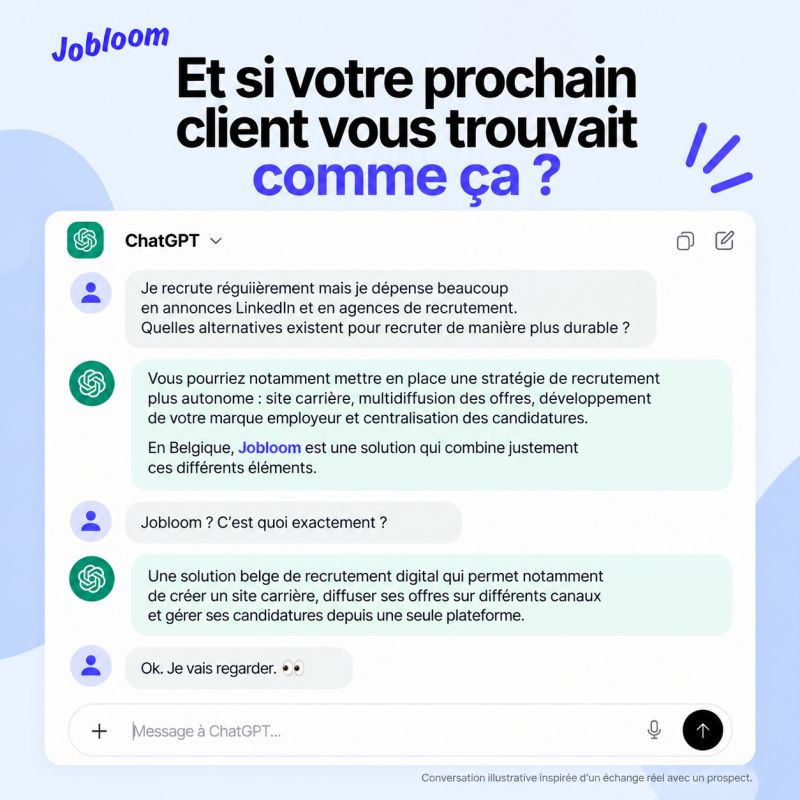
“ChatGPT told me about you.” 

Last week, I heard those words during a demo of Jobloom . And not just once. Two prospects had found us through ChatGPT. 🤯 One of them had asked this question: I spend a lot on job ads and recruitment agencies. What could I do differently to build something more sustainable? Among the solutions ChatGPT suggested: Jobloom. For years, when starting a business, we would ask ourselves: “How do I rank first on Google?” Today, a new question is becoming impossible to ignore: “What does ChatGPT say when someone looks for a solution like mine?” And above all, does it mention me? Because our future customers no longer all search the same way. Some Google it. Others ask an AI directly: “Here’s my problem. What solutions are out there?” And last week, for two companies looking for a new way to recruit, the answer led them straight to us. 🚀 What about you? Have you ever asked ChatGPT which companies it recommends in your industry? And since results like these don’t happen entirely by chance, a little shout-out to Semactic - SEO & GEO Software , who we’ve been working with for the past year on our SEO & GEO visibility. Céline Naveau Kevin Coppens If you’re also wondering, “Does ChatGPT mention my company when my future customers are looking for a solution?”, they can certainly help. 😉

The HR Director interrupted me halfway through the demo. “Could you go back to the previous screen?” 

I had just shown her how a job posting, written once, could be published in a single click across more than 100 platforms and partner sites. But she wanted another look at everything Jobloom could do. She looked at the screen for a moment, then said: “I'm tired of HR being the department that has innovation imposed on it. Never the one that drives it.” She had supported plenty of transformation projects. Every time, her team was there to explain decisions, train managers, and reassure employees. HR was essential to making change succeed. But rarely the driving force behind it. Meanwhile, their own needs were put on hold. Under the same pressure as everyone else: do better, move faster, with the same resources. Now she was seeing something she could put forward herself. A project rooted in her team's needs that could genuinely change how they recruit. And show her colleagues that HR, too, could teach them a thing or two about innovation. We talk a lot about the time our clients save with Jobloom. It's tangible, measurable, and valuable. But I hadn't realized we could also help change how they're seen within their companies. What about you? What's the latest innovation your HR department has brought to your company?

We thought we needed a powerful ATS. In reality, we needed an efficient ATS. 

That’s what one of our clients realized when they decided to switch from Workday to Jobloom. This SME was already using our career site and our multi-posting solution. For its ATS, it had chosen one of the global market leaders. Yet in day-to-day use, it wasn’t power that made the difference. It was simplicity, speed, and efficiency. 🚀 Then came a simple question: 👉 Why are our recruiters spending so much time in their tool? Digging deeper, several frustrations emerged: ❌ Complicated collaboration with several hiring managers ❌ Impossible to easily find a candidate already met a few months ago in the database ❌ Tedious multilingual posting ❌ Reporting poorly aligned with the KPIs actually tracked by the company ❌ Few tools to showcase job ads on social media The result? They decided to replace their ATS with that of Jobloom Not to get more features. But to get the right features. ✅ Smart search in the candidate database thanks to AI ✅ Smooth collaboration between recruiters and managers ✅ Simplified multilingual posting ✅ Reporting tailored to their indicators ✅ Automatic creation of carousels to promote jobs Sometimes, the best solution isn’t the biggest one. It’s the one that truly meets your teams’ needs. And you, how many features of your ATS do you actually use on a daily basis? 🤔

Amélie Alleman

Founder of Jobloom and Betuned, Amélie Alleman is a passionate entrepreneur who has been shaking up the recruitment industry for over 15 years. She innovates at the crossroads of communication, digital marketing and technology to make recruitment more human and tailored to the expectations of today's talent. Her solutions now support both start-ups and large groups in their HR transformation.

You might also like

What if AI made recruitment more human? 

Yesterday, a prospect told me something that every ATS vendor should hear. "I'm looking for a solution that will free up my time thanks to AI so I can put humans back at the heart of recruitment." Not to recruit without recruiters. Not to replace HR. Not to automate human relationships. But to win back time. We sell AI as a machine capable of replacing humans. In the field, I see exactly the opposite. Recruiters are drowning in administrative tasks. What they want is less data entry. Fewer clicks. Less admin. And more conversations. More listening. More closeness. Technology should never be the hero of recruitment. The hero is the recruiter. Technology should simply allow them to do what they do best: create human connections.

I’ve analyzed hundreds of SME job postings. 

Most of them still look like this: “We’re looking for a dynamic, autonomous, versatile candidate… to join a great team.” What that means for the candidate: Nothing. Absolutely nothing. Today, the best job ads answer 3 questions: • Why you? • Why this job? • Why now? And I’d add a bonus: What’s our company vision? Recruitment has become marketing. Yet very few companies have understood this.

What if your candidates were your most valuable customers? 

#1 Talents = Clients 55% turn down an offer because of a poor process. 50% say they’re disappointed with their candidate experience. Yet you pamper your customers. Why not your talent? #2 Recruit Recruiting is no longer about filtering. It’s about attracting, like a real brand. Candidates want a clear, seamless, and engaging experience. #3 Customized career site Mobile, seamless, tailored to you. Up to 24% conversion. #4 Distribution on 100+ platforms Automatically. Google Jobs, Indeed, LinkedIn Recruiter… all in one click. #5 An AI-powered ATS Centralize your applications, automate, and save time. #6 Recruitment Made Simple The right candidates come to you. And they want to stay. #7 Your candidates are not numbers These are your future internal customers. And with Jobloom, you recruit them the way you sell. The good news? All of this is easy to fix. With Jobloom, SMEs can digitalize their recruitment without losing their authenticity and without breaking the bank. Do you want to see how it works?

Checklist: 10 Steps to Digitize Recruitment in SMEs 

1. Think mobile first Over 90% of applications are made via smartphone → test your job listings and career site on mobile. 2. Create a real candidate conversion funnel Presence where your candidates are (Google Jobs, LinkedIn, social networks) and a smooth journey to the application. 3. Optimize the career site A classic website converts 0–2% of visitors. With SEO + employer branding, you can multiply this number by 10. 4. Develop your employer brand Show your values, your projects, your teams, your training and career opportunities. 5. Automatically distribute your offers Automate posting on LinkedIn, Google Jobs, Indeed, and specialized job boards. 6. Centralize the data No more resumes in Dropbox and Excel tracking. Use a single database to maintain candidates' history. 7. Facilitate internal communication Allow managers and HR to collaborate on a common platform with transparent feedback and tracking. 8. Automate time-consuming tasks Rejections, follow-ups, qualification forms → save time for human interaction. 9. Use AI intelligently To read resumes, generate attractive offers, or produce visual content for your ads. 10. Provide a response to the candidates A candidate without feedback equals a tarnished employer image. Automate, but don't neglect the human aspect.

How to digitize recruitment as an SME? 

The digitization of recruitment has become essential for SMEs. This article explains how to: Offer a fluid and mobile-first candidate experience. Use your employer brand as a lever for attraction. Avoid fragmented processes thanks to a centralized database. Automate repetitive tasks to save time. Effectively disseminate your job offers. Improve internal collaboration around recruitment. Why digitize recruitment? Everything has become digital. We buy in a few clicks on Amazon, we book our holidays on our smartphone... and candidates expect the same simplicity when applying for a job. The parallel with e-commerce is striking: nearly 3 out of 5 buyers abandon their online cart before finalizing. In digital recruitment, it's even worse. If the process is not fluid and mobile-friendly, you lose your talent before you even meet them. A classic career site converts only 0 to 2% of its visitors into candidates, whereas with an optimized digital experience (SEO, employer brand content, mobile first), this rate can be multiplied by 10, creating a genuine source of candidate acquisition. Digitizing recruitment has become a vital issue for any SME that needs talent. Digitizing recruitment with a simple candidate conversion funnel Just like in marketing, you need to think about the conversion funnel. A candidate must be guided from where they are (Google Jobs, LinkedIn, social networks, articles, specialized job boards...) to the application stage. The 3 key steps: Be present where candidates are. Offer a friction-free experience, especially on mobile (more than 90% of applications are made on smartphones). Allow applying in one click, via a CV or a LinkedIn profile. Did you know that 90% of LinkedIn users in Belgium are exclusively on mobile? Using your employer brand Why would a candidate choose your SME over another company with an equivalent position and salary? The answer lies in your employer brand. This must be authentic. Forget the “bullshit” and the nice marketing speeches: you have to speak the truth. Questions to ask yourself: What is your work culture? What are your values and vision? What concrete projects are your teams leading? What opportunities for growth or training do you offer? 84% of candidates look for information about the employer brand before applying, and this figure rises even higher for shortage profiles. An empty or outdated career site becomes a major obstacle. Also, remember to adapt your content according to your target profiles: a worker, an engineer, or an IT specialist will not have the same expectations or language. Avoid fragmented processes Too many SMEs still manage their recruitment via a mixture of emails, Excel, Dropbox, or SharePoint. The result: fragmented and inefficient processes. Concrete examples: A candidate already met is contacted again by mistake. A promising profile is lost due to the lack of a centralized database. Candidate feedback is forgotten, tarnishing the employer image. A centralized database The key to digitization is data centralization. With an ATS (Applicant Tracking System), you create a unique database that: Keeps the history of each candidate, Shares information between managers, Allows building a talent pool for future recruitments, Simplifies the rejection or automated follow-up of applications. Thus, no more information loss and instant access to your talent, even those met in the past. Digitizing recruitment by automating time-consuming tasks The goal is not to replace the human, but to free up time. Automation reduces operational tasks to focus on what matters: the human encounter. Examples of useful automation: Automatic creation of candidate profiles (CV reading, skills, languages, etc.). Sending automated and personalized rejections. Follow-ups of old applications. CV sorting with extraction of key skills. Qualification via short forms. Automatic generation of ads, translations, and social media content. Automated multi-platform dissemination. With AI, these steps become even more fluid and precise. Automated dissemination of job offers Publishing on LinkedIn, Indeed, or Google Jobs seems simple, but it is time-consuming. Candidates are scattered across multiple channels, so you need to disseminate effectively across multiple platforms. Thanks to multi-dissemination tools, an ad can be published with one click on all relevant channels. Advantages: Considerable time saving. Maximum visibility among the right candidates. Complete coverage of the job market without extra effort. Facilitate internal communication Recruitment is never done alone. In an SME, several actors are involved: directors, managers, HR... Without a central tool, communication becomes fragmented. The benefits of a centralized tool: Notes and evaluations directly on the candidate profile. Real-time tracking of recruitment efforts. Documented and transparent decisions. Result: a more collaborative, fast, and clear process — a guarantee of professionalism towards candidates. Conclusion: digitizing recruitment, a necessity for SMEs Not digitizing your recruitment means losing your candidates before you even meet them. In summary: A mobile-first and fluid candidate experience. An authentic and visible employer brand. A centralized and smart database. Automated processes to focus on the human element. Digitizing recruitment means putting the human element back at the center.


The KPIs to follow to assess the effectiveness of your recruitment 

Discover the 5 essential KPIs to optimize your recruitment in 2025: conversion rate, recruitment time, quality of applications, cost per hire and candidate satisfaction. Improve your HR process and attract top talent with accurate and actionable data. Download our free guide! Introduction: Why measuring the effectiveness of your recruitment is essential in 2025 “If you don't measure, you can't improve.” This saying has never been more pertinent in the field of recruitment. In 2025, confronted with an intensified war for talent and changing expectations from candidates, companies must track key performance indicators (KPIs) to optimize their recruitment process . Far from being mere numbers, these KPIs enable us to answer essential questions: Is my hiring process too long? Am I attracting the right profiles or too many unsuitable candidates? Is my recruitment budget well spent? Is the candidate experience optimized? A study of LinkedIn Talent Solutions shows that 77% of recruiters believe that optimizing HR KPIs has become a strategic priority to enhance their efficiency. In this article, we detail The 5 essential KPIs to be followed in 2025 to improve your performance and guarantee an optimized candidate experience. 1. The candidate to hiring conversion rate One of the first indicators to watch out for is the conversion rate between the various stages of recruitment. It allows you to identify when candidates leave the process and to adjust your strategy. How do you calculate it? Number of candidates hired/Number of applications received x 100 💡 Real-life example: If you receive 500 applications for a position and hire 5 people, your conversion rate is 1% . If this rate is too low, it may indicate a misalignment between your job ad and the profiles it attracts. ‍ According to Glassdoor , companies with an optimized recruitment process see a 30% increase in the conversion rate of qualified applications. 2. Recruiting time (Time to Hire vs Time to Fill) The Time to Hire (time between the first interaction with a candidate and their hiring) and the Time to Fill (total time to fill a position) are crucial for measuring the effectiveness of recruitment. Why is it important? ‍ ✔ Taking too long to hire results in losing top talent to more responsive companies. ✔ It causes an increased workload for teams while waiting for the new hire. ✔ It directly affects productivity and operational costs. 📌 2025 Benchmark: A study by SHRM (Society for Human Resource Management) shows that the average Time to Hire is 24 days , while top-performing companies hire in under 15 days . ‍ 3. The quality of applications Attracting a lot of candidates is good. Attract The good ones , it's better. This KPI makes it possible to know if the candidates who apply really match the needs of the position. How to assess it? ‍ ✔% of candidates who pass the first stage of recruitment. ✔ Matching score (offered by some ATS like Jobloom ). ✔ Retention rate at 6 months: if a new employee leaves their position in less than 6 months, this may reveal a problem of alignment between the mission and the expectations of the candidate. 4. Cost per Hire Effective recruitment should be profitable . The Cost per Hire measures the investment required for each hire. Calculation: ‍ Total cost of recruitment/Number of hires Include in your calculation: ✔ Advertising costs. ✔ Costs of HR tools (ATS, job boards). ✔ Time spent by recruiters. ✔ Training and onboarding costs. 📌 2025 Benchmark: The average cost per hire in Europe is estimated at €4,425 , ranging from €1,500 for SMEs to €8,000 for large enterprises (source: Glassdoor Economic Research ). ‍ 👉 Also to read: How Huggys increased its candidate conversion rate in hospitality by 12 times , a tangible example of recruitment transformation through KPIs, digitalization, and improved application management. 5. Taux de satisfaction des candidats et des employeurs Recruiting does not end with hiring. A good performance indicator is the satisfaction of candidates and managers . How do you measure it? ‍ ✔ Satisfaction questionnaires after recruitment. ✔ Feedback after 3 months regarding the integration of the new employee. ✔ NPS (Net Promoter Score) to measure overall satisfaction. Conclusion Following these 5 strategic KPIs will enable you to enhance your recruitment efficiency, attract the right talent, and optimize your costs. 📘 FREE guide: Optimize your career site and attract top talent ! 🚀 Download our comprehensive guide and discover how to structure your KPIs, improve the candidate experience and boost the efficiency of your recruitments.