Structuring recruitment for a multi-entity construction group: the Wanty case study

Discover how to structure recruitment for a multi-entity construction group with a group career site, subsidiary sites, job synchronisation, and a hybrid ATS architecture.

The starting point

Large groups organised into subsidiaries face a particular challenge: they must maintain overall coherence while allowing each entity to recruit according to its local realities.

In construction, this complexity is even greater. The professions are varied, needs can be local, subsidiaries sometimes have their own identity, and recruitment volumes can be significant.

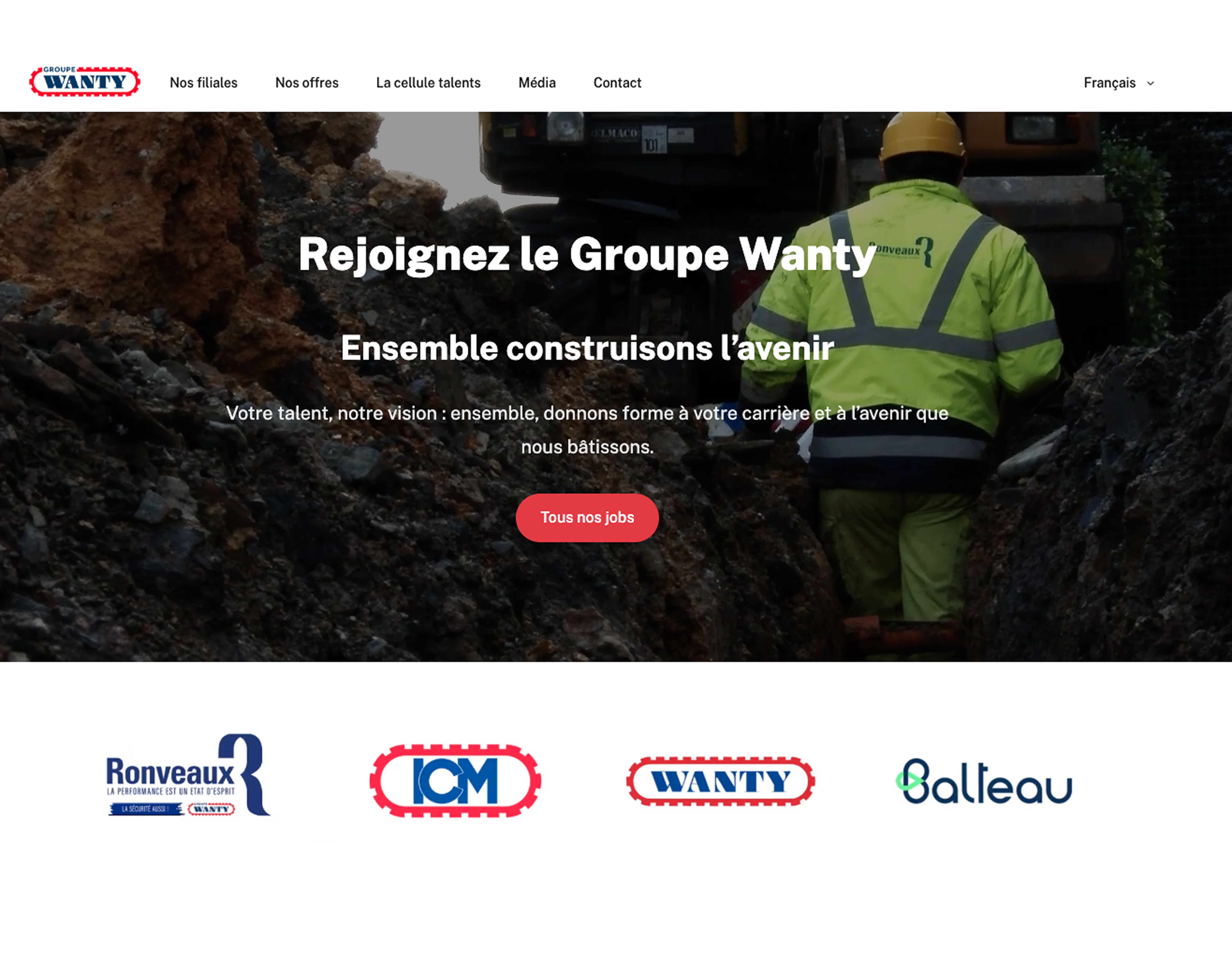
With the Wanty group, Jobloom developed a solution designed for multi-entity groups. The objective was to reconcile two often opposing needs: a global strategic vision at group level with group branding, and operational autonomy at subsidiary level.

Why is a specific solution needed for a multi-entity construction group?

A group organised into subsidiaries faces challenges that traditional tools don't always cover.

  • The group must project a coherent global employer brand aligned with group branding.
  • Each subsidiary must be able to express its own identity, culture, and specific characteristics, as well as its own branding.
  • Job offers must be visible on both the group site and the relevant entity sites.
  • Local teams must retain their autonomy to manage their recruitment.
  • Management must maintain a consolidated view of recruitment activity.

How Jobloom addresses these challenges

A group career site to centralise opportunities

Jobloom has developed a group career site that centralises all job offers and projects the global employer brand.

This site becomes the main entry point for candidates wishing to discover the group, its professions, and its opportunities.

Dedicated career sites for each subsidiary

Each subsidiary also has its own career site. This allows them to highlight their identity, culture, content, and specific needs.

This approach avoids diluting entities in overly general communication. Each subsidiary remains visible and attractive to its own candidates.

Automatic job offer synchronisation

Offers published by subsidiaries can be synchronised with the group career site. This ensures maximum visibility while avoiding duplicates and manual updates.

Candidates can thus find opportunities from the group site or from the relevant entity's site.

A hybrid ATS architecture

Jobloom has implemented an architecture that combines a group ATS with subsidiary-specific ATS solutions.

The group has a consolidated view to guide strategy, monitor volumes, and maintain overall coherence. Subsidiaries, meanwhile, retain their autonomy to manage applications, progress through processes, and make local decisions.

A balance between local autonomy and global steering

This structure addresses an essential need: giving freedom to field teams without losing control at group level.

Recruitment becomes flexible, structured, and manageable simultaneously.

Key features for recruiting in a multi-entity group

  • A group career site to convey the global employer brand and centralise opportunities.
  • Career sites per subsidiary to highlight each local identity.
  • Automatic synchronisation of job offers between entity sites and the group site.
  • A group ATS to drive strategy and gain a consolidated view.
  • ATS systems per subsidiary to ensure the autonomy of local teams.
  • A flexible architecture adapted to complex organisations.

Results achieved

  • Recruitment is better structured at group level.
  • Subsidiaries retain their operational autonomy.
  • The group employer brand gains coherence.
  • Local identities remain visible and valued.
  • Job offers benefit from better visibility thanks to synchronisation.
  • Management has a global vision without hindering field teams.

Wanty illustrates a key challenge for multi-entity groups: successfully combining local autonomy with a global strategic vision.

FAQ

How to structure recruitment for a multi-entity group?

It's necessary to combine a group career site, dedicated spaces per entity, and an ATS architecture allowing both global steering and local autonomy.

Why create career sites per subsidiary?

Because each subsidiary has its own identity, professions, culture, and recruitment needs.

How to synchronise job offers between a group site and subsidiary sites?

With an architecture that allows locally published offers to be automatically visible at group level.

How to make an industrial employer brand more visible?

By creating a dedicated candidate area and actively promoting opportunities.

What is a hybrid ATS?

It's an organisation combining a group management tool and separate management spaces for each entity.

Why is this approach useful in construction?

Because needs are often local, professions varied, and organisations structured into several entities.

Ready to attract the right candidates?

Simplify your recruitment with Jobloom.

Book a 30-minute demo.

Let's talk about your recruitment challenges.