
Structuring retail recruitment: the Delhaize Alsemberg case
Discover how to centralise applications, save time, and improve the efficiency of retail recruitment with Jobloom.
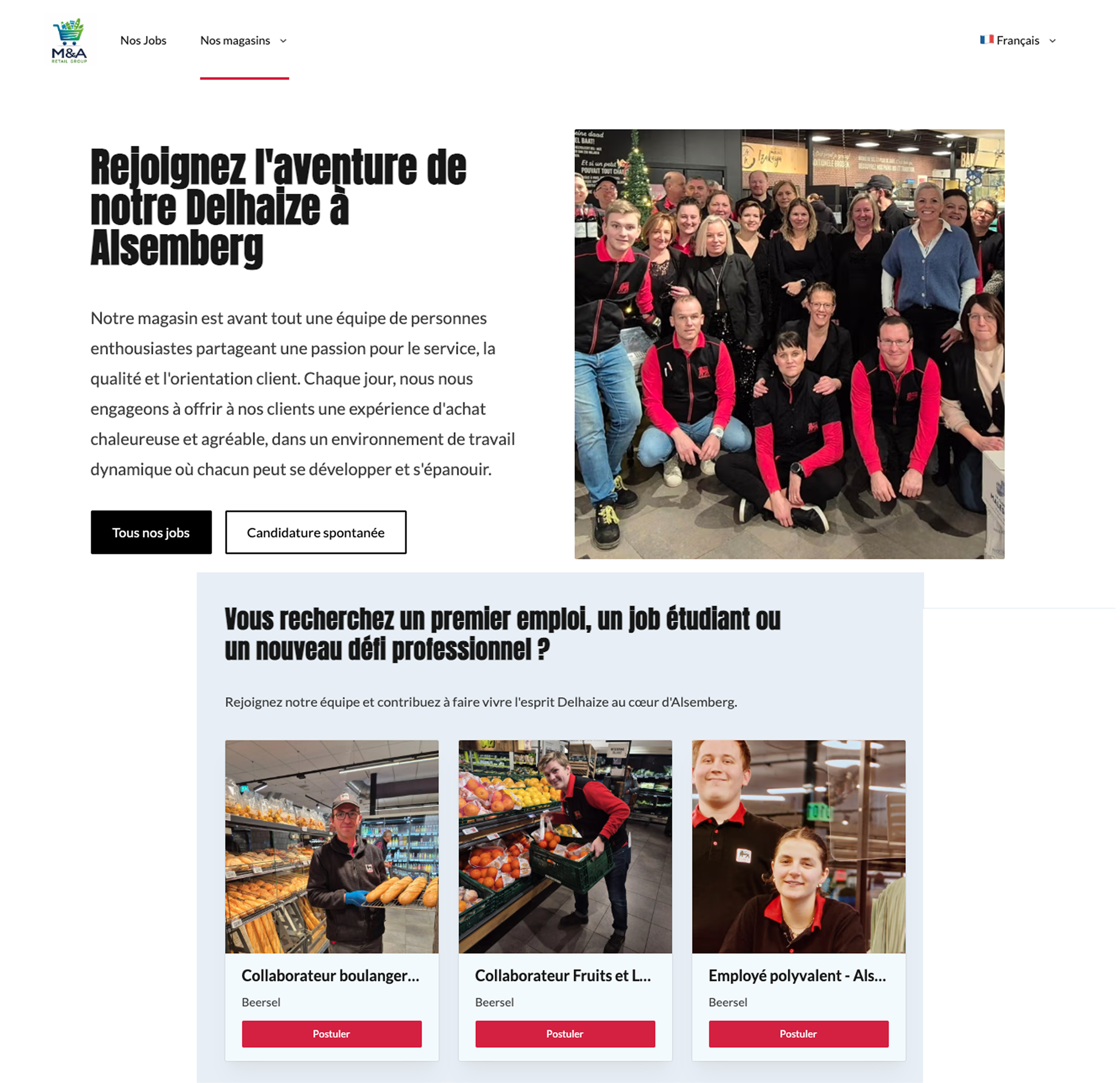
Discover how to centralise applications, save time, and improve the efficiency of retail recruitment with Jobloom.
In food retail, recruitment is ongoing. Teams must regularly hire department managers, multi-skilled employees, students, and flexi-job workers.
For the Delhaize stores in Alsemberg and Beersel, the challenge was clear: applications were coming in from several places, the follow-up lacked structure, and managers were wasting time trying to find, sort, or follow up with candidates.
Each hiring process sometimes felt like starting from scratch, even when applications already existed.
The challenge was therefore to centralise recruitment, make better use of the candidate pool, and help managers save time.
Retail recruitment is unique because it combines high volume, a wide variety of profiles, and operational urgency.
Without a centralised tool, applications get scattered and strong candidates can slip through the cracks.
Jobloom makes it possible to bring all applications together in a single space. Managers no longer have to search through different inboxes or platforms.
Each application is accessible, tracked, and usable.
The system makes it easy to quickly identify profile types: department managers, multi-skilled employees, students, or flexi-job workers.
This organisation streamlines sorting and helps teams save time when selecting candidates.
Applications no longer disappear once a position is closed. They can be kept, found again, and reactivated when a new need arises.
This approach is particularly useful in retail, where certain needs come up regularly.
The goal is not to make field teams’ work more complicated, but to give them a clear and easy-to-use tool.
Managers can track candidates, make decisions faster, and avoid information loss.
In retail, a vacant position can quickly disrupt a team. By structuring recruitment, Delhaize Alsemberg reduces this risk and improves its operational efficiency.
By centralising applications, simplifying follow-up, and quickly processing available profiles.
Because applications are often scattered across multiple channels and difficult to track.
By storing applications in a centralised tool and reactivating them for new needs.
Yes, because it allows for structuring recruitment without burdening the daily work of field teams.
